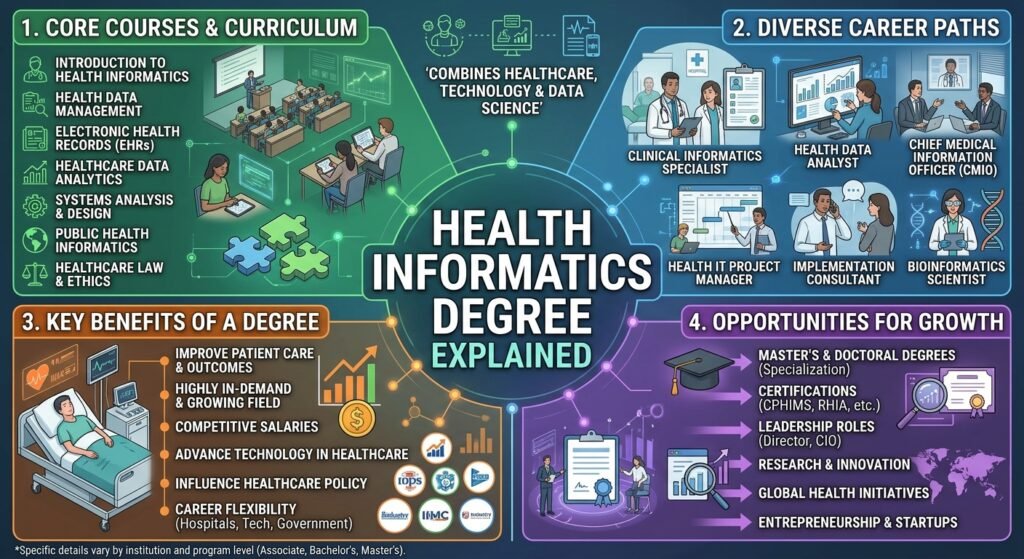

Healthcare is becoming more dependent on digital technology. Hospitals, medical laboratories, clinics, and public health organizations use computerized systems to manage patient records, organize medical information, and support healthcare decisions. As these technologies develop, understanding how healthcare information is collected, protected, and used has become increasingly important.
A Health informatics degree is an educational pathway that combines healthcare knowledge with information technology, data management, and digital systems. It helps students understand how technology supports healthcare organizations and how accurate information can contribute to better healthcare services.
This degree may interest students who enjoy working with computers, analyzing information, solving problems, and understanding healthcare operations. It can also provide opportunities for healthcare professionals and IT graduates who want to develop specialized knowledge.
What Is a Health Informatics Degree?
A health informatics degree is an academic qualification focused on managing, analyzing, and using healthcare information through technology. It combines healthcare, information science, computer technology, and related disciplines.
Students learn how healthcare organizations collect patient information, maintain electronic records, exchange medical data, and use digital systems to support their operations.
Understanding the Meaning of Health Informatics
Health informatics is an interdisciplinary field that uses data, information, and technology to support individual and population health.
Health informatics degree involves collecting, organizing, storing, analyzing, and sharing health-related information. Its applications include electronic health records, clinical decision-support systems, telehealth, mobile health applications, and healthcare research.
In simple terms, health informatics helps transform medical information into useful knowledge that healthcare professionals and organizations can use responsibly.
How Health Informatics Combines Healthcare and Technology
Healthcare professionals understand medical services and patient needs, while IT professionals understand software, databases, and computer systems. Health informatics connects these areas.
Why Health Informatics Matters in Modern Healthcare
Healthcare organizations handle significant amounts of information, including patient histories, prescriptions, diagnostic reports, and treatment records.
Managing this information accurately helps support communication, documentation, research, and healthcare administration.
Health informatics also supports interoperability, which allows different information systems to exchange and use healthcare information. This is important when patients receive services from multiple healthcare providers.
What Do You Learn in a Health Informatics Degree Program?
A health informatics degree program combines healthcare subjects with technical and analytical education. The specific courses vary, but students commonly explore the following areas.
Healthcare Information Systems and Management
Students learn how hospitals and healthcare organizations use computerized systems to manage medical information and daily operations. Topics may include hospital information systems, clinical software, databases, information governance, and technology implementation.
Medical Data Analysis and Health Statistics
This subject introduces students to statistics, data interpretation, research methods, and analytical techniques.
Students may learn how to examine healthcare information, identify patterns, prepare reports, and explain findings. These skills can support research and organizational decision-making.
Electronic Health Records (EHR) and Digital Health Technology
Electronic health records are digital systems used to maintain patient health information. Students may explore medical documentation, patient information management, laboratory records, clinical decision-support systems, telehealth, and healthcare information exchange.
Healthcare Data Security and Patient Privacy
Patient information must be handled responsibly because medical records contain sensitive personal details.
Students may study cybersecurity, access controls, privacy policies, information governance, and data protection. They may also learn about regulations such as HIPAA, which applies to covered organizations and business associates in the United States.
What Are the Different Types of Health Informatics Degrees?
Health informatics education is available at different academic levels, although not every institution offers every qualification under the same degree title.
Associate Degree in Health Informatics
An associate degree provides introductory undergraduate education. Related programs may focus on medical records, health information technology, healthcare administration, and computer applications.
Health informatics degree may provide a foundation for certain entry-level healthcare information positions, depending on employer requirements.
Bachelor’s Degree in Health Informatics
A bachelor’s degree offers broader education in healthcare information systems, databases, statistics, information management, and digital healthcare.
It can prepare students for further education or positions involving healthcare technology, information systems, and data support.
Master’s Degree in Health Informatics
A master’s degree provides advanced study in areas such as clinical informatics, healthcare analytics, information systems, research, and technology management.
Health informatics degree may be suitable for graduates interested in specialist responsibilities, project leadership, or advanced healthcare technology roles.
Doctoral Degree in Health Informatics
Doctoral education focuses on advanced research, academic investigation, and specialized professional knowledge.
Students may investigate healthcare artificial intelligence, clinical information systems, biomedical data science, or digital healthcare policies.
What Are the Admission Requirements for a Health Informatics Degree?
Admission requirements depend on the university, degree level, and country. Applicants should always review the official requirements before submitting an application.
Educational Qualifications and Academic Background
Undergraduate applicants generally need to complete the required secondary education. Graduate applicants usually need a recognized bachelor’s degree.
Relevant academic backgrounds may include healthcare, nursing, public health, computer science, engineering, statistics, and information technology.
Some universities accept students from different disciplines, while others require specific prerequisite subjects.
Technical and Computer Skills
Basic computer literacy is helpful because students regularly work with digital systems and information.
Some programs also require mathematical, statistical, or programming knowledge. However, advanced programming experience is not necessary for every health informatics qualification.
Application Requirements and Prerequisites
Universities may request academic transcripts, certificates, application forms, recommendation letters, and personal statements.
International applicants may also need English-language proficiency evidence and recognized educational qualifications. Certain graduate programs may require relevant professional experience or previous coursework.
What Skills Can You Develop With a Health Informatics Degree?
Studying health informatics can help develop technical, analytical, and professional abilities that are relevant to healthcare information management.
Healthcare Data Management Skills
Students learn how medical information is collected, organized, maintained, and used. They may develop knowledge of electronic records, information accuracy, documentation, and database management.
Analytical Thinking and Problem-Solving
Healthcare organizations sometimes experience difficulties involving incomplete records, information systems, or reporting processes. Students develop analytical abilities by examining information, identifying problems, and evaluating possible solutions.
Technology and Information Systems Skills
Depending on the curriculum, students may gain experience with healthcare software, electronic records, database concepts, reporting tools, and digital information systems.
Communication and Teamwork Skills
Health informatics professionals often collaborate with doctors, nurses, administrators, researchers, and IT specialists. Communication skills help them explain technical information, understand user requirements, and contribute to technology projects.
What Can You Do With a Health Informatics Degree?
A health informatics degree can provide a foundation for several career pathways. However, job responsibilities and qualification requirements differ between employers.
Health Informatics Specialist
Health informatics specialists help healthcare organizations manage and improve information systems. Their responsibilities may involve digital record management, software implementation, workflow evaluation, and information system support.
Clinical Informatics Analyst
Clinical informatics analysts examine how healthcare professionals use digital systems. They may gather user requirements, evaluate clinical workflows, support software implementation, and help improve electronic documentation. Some positions require previous clinical experience.
Health Information Manager
Health information managers oversee medical information processes, documentation quality, record management, and privacy procedures. Certain positions require specialized health information management education or professional credentials beyond a general health informatics degree.
Healthcare Data Analyst
Healthcare data analysts examine medical and operational information to prepare reports and identify patterns. They may use spreadsheets, databases, statistical software, and visualization tools to support healthcare research and organizational planning.
Clinical Systems Administrator
Clinical systems administrators help maintain healthcare software and information systems. Their responsibilities may include system configuration, user access management, troubleshooting, updates, and technical support. Employers may also require practical IT experience.
Health Informatics Degree Salary and Career Opportunities
Salary expectations depend on education, experience, location, specialization, and employer. There is no universal salary for everyone holding a health informatics degree.
Factors That Influence Salary Expectations
Important factors include professional experience, technical knowledge, job responsibilities, academic qualifications, and the type of healthcare organization.
For a U.S. reference point, the Bureau of Labor Statistics reported a median annual wage of $68,020 in May 2025 for health information technologists and medical registrars. It also projected 16% employment growth for this occupational group between 2025 and 2035.
Industries That Hire Health Informatics Graduates
Potential employment settings include hospitals, medical laboratories, healthcare software companies, research institutions, public health organizations, insurance companies, and government healthcare agencies.
Career Growth and Professional Development
Professionals can develop their careers by gaining practical experience, improving technical knowledge, and pursuing additional education or relevant certifications.
Specializations may include healthcare analytics, clinical systems, information security, health information management, and digital healthcare technology. Continuous learning is important because healthcare systems and technology change over time.
What Are the Benefits of Earning a Health Informatics Degree?
Opportunities in the Digital Healthcare Industry
The degree introduces students to the digital systems used by modern healthcare organizations. This knowledge may be relevant to positions involving healthcare technology and information management.
Combining Healthcare Knowledge With Technology
Students explore how technology supports medical information and healthcare operations. This can appeal to people interested in healthcare who prefer working with information systems rather than providing direct medical treatment.
Diverse Career Paths and Specializations
Health informatics covers several areas, including clinical information systems, healthcare analytics, electronic records, digital health, and information management.
Opportunities for Further Education
Graduates may pursue postgraduate qualifications in health informatics, biomedical informatics, public health, healthcare management, or data analytics. Further study can help develop specialized knowledge and prepare students for advanced professional responsibilities.
What Are the Challenges of Studying Health Informatics?
Understanding Complex Healthcare Technologies
Healthcare systems involve databases, software, clinical processes, and information-sharing requirements. Students without previous technical experience may need additional practice to understand these subjects.
Managing Data Privacy and Cybersecurity
Protecting patient information requires knowledge of privacy regulations, security practices, and responsible data handling.
Adapting to Changing Healthcare Systems
Digital healthcare technology continues to evolve. Professionals need to learn new systems, information standards, and security practices throughout their careers.
Online vs. Traditional Health Informatics Degree Programs
Benefits of Online Health Informatics Programs
Online programs can offer flexibility for students balancing education with employment or other responsibilities. They may include recorded lectures, digital learning materials, online assignments, and virtual discussions.
Advantages of On-Campus Learning
Campus-based education provides direct interaction with lecturers and classmates. Students may also access computer laboratories, research facilities, practical activities, and academic support.
Choosing the Right Learning Format
Compare institutional recognition, curriculum quality, practical training, tuition fees, and examination arrangements. The best format is the one that supports your educational needs while providing a recognized and appropriate qualification.
How to Choose the Best Health Informatics Degree Program
Checking Accreditation and Institutional Reputation
Check whether the university is officially recognized and whether the specific program has relevant accreditation.
In the United States, CAHIIM provides accreditation for eligible health informatics programs. Its accreditation information distinguishes health informatics from health information management, so students should verify the exact program.
Reviewing the Course Curriculum
Examine subjects such as healthcare information systems, electronic health records, statistics, data analysis, information security, and healthcare management. Choose a curriculum that matches your intended career direction.
Evaluating Internship and Practical Learning Opportunities
Practical projects, internships, supervised assignments, and industry partnerships can help students understand how healthcare information systems work. Check whether placements are guaranteed, optional, or subject to additional requirements.
Comparing Tuition Fees and Financial Aid
Compare tuition, registration costs, examination fees, and additional educational expenses. Also investigate scholarships, grants, and available financial assistance before enrolling.
Read more: Xendit Work GamificationSummit: Facts, Context, and Common Questions
Is a Health Informatics Degree Worth It?
A health informatics degree may be worthwhile for individuals interested in healthcare technology, medical information, and data management.
However, its value depends on personal interests, educational costs, program quality, and employment opportunities.
Who Should Consider Studying Health Informatics?
This degree may suit students interested in healthcare and computers, IT professionals exploring digital healthcare, healthcare workers interested in information systems, and analytical thinkers who enjoy working with data.
Long-Term Career and Educational Prospects
Health informatics offers possible career directions in information management, healthcare analytics, clinical systems, research, and digital technology.
Employment prospects vary between countries and occupations. Students should examine local job advertisements and employer qualification requirements rather than relying entirely on international statistics.
Important Factors to Consider Before Enrolling
Before applying, consider your career goals, university recognition, curriculum, practical experience, tuition costs, technical interests, and local employment opportunities. These factors can help you determine whether the qualification is a suitable investment in your education.
Final Thoughts
A Health informatics degree provides an opportunity to understand how healthcare, information, and technology work together. Students explore important subjects such as electronic health records, healthcare databases, medical data analysis, and information security.
The qualification can support different educational and career directions, including healthcare analytics, clinical information systems, health information management, and digital healthcare technology.
However, choosing the right program requires careful research. Students should examine university recognition, course content, practical learning opportunities, admission requirements, and financial commitments before enrolling.
FAQs About Health Informatics Degrees
1. What is a health informatics degree used for?
A health informatics degree develops knowledge of healthcare information systems, electronic health records, medical data management, and digital healthcare technology.
2. How long does it take to complete a health informatics degree?
The duration depends on the degree level, university, and study arrangement. Associate, bachelor’s, master’s, and doctoral qualifications have different academic requirements.
3. Is a health informatics degree worth pursuing?
It may be a valuable option for people interested in combining healthcare and technology. Its value depends on program recognition, course quality, tuition costs, practical experience, and available employment opportunities.
4. Can I earn a health informatics degree online?
Yes. Some universities offer online health informatics programs. Applicants should check institutional recognition, accreditation where applicable, practical requirements, and examination arrangements.
5. Do you need a medical background to study health informatics?
No. Many programs accept applicants from healthcare, computer science, engineering, information technology, and related academic backgrounds.