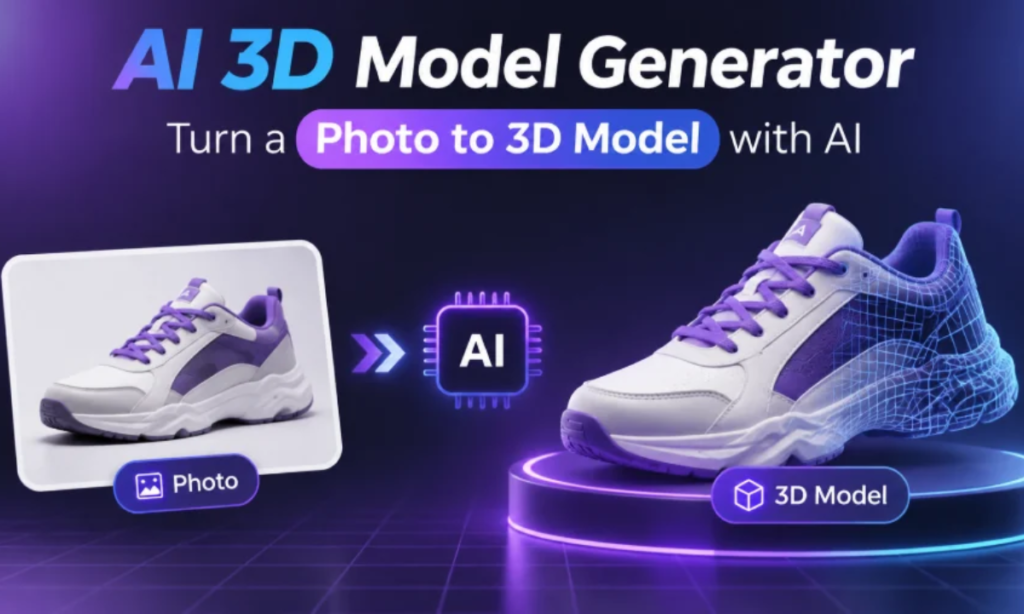

Creating 3D models traditionally requires specialized software, technical knowledge, and hours of manual work. From designing objects to adjusting shapes, textures, and dimensions, the entire process can be challenging for beginners and time-consuming for experienced designers. However, artificial intelligence is changing how people approach 3D modeling. With an AI 3D model generator, users can turn creative ideas and visual references into 3D assets more efficiently without relying entirely on traditional modeling techniques.
Whether you are a graphic designer, game developer, digital artist, product designer, or content creator, AI-powered 3D generation tools offer new opportunities to bring creative concepts to life. Instead of building every object from scratch, you can use images or descriptions as starting points and let AI assist with the modeling process.
In this article, we will explore how AI 3D model generators work, their benefits, practical applications, and how image-to-3D technology is making 3D creation more accessible.
What Is an AI 3D Model Generator?
An AI 3D model generator is a technology that uses artificial intelligence to create three-dimensional digital objects from visual references or text descriptions. It analyzes the provided input, identifies important visual characteristics, and generates a corresponding 3D representation.
Traditional 3D modeling usually involves working with vertices, edges, polygons, and complex modeling tools. AI-powered solutions simplify many of these processes by automating parts of the creation workflow.
Depending on the platform, users may be able to generate 3D models from:
- Text descriptions of objects or characters.
- Photographs and product images.
- Digital illustrations and concept art.
- Visual references of everyday objects.
- Creative designs and architectural concepts.
This technology is particularly useful for people who want to experiment with 3D design without spending months learning advanced modeling techniques.
How Does AI 3D Model Generation Work?
AI-powered 3D generation involves several processes that help transform two-dimensional or text-based information into three-dimensional structures.
Input Analysis
The process begins when a user uploads an image or enters a text description. The AI system analyzes the available information to identify the object’s shape, structure, proportions, colors, and other visual characteristics.
Shape and Structure Estimation
After analyzing the input, the system estimates the object’s three-dimensional structure. It attempts to understand how different surfaces and components relate to one another in 3D space.
3D Model Generation
Using its trained models and generation techniques, the AI creates a three-dimensional representation. The resulting asset may include geometry, surface details, and textures, depending on the tool.
Preview and Refinement
Once generated, users can inspect the model and determine whether it meets their requirements. Additional editing may be necessary to improve geometry, adjust proportions, or prepare the asset for a particular application.
Although AI can automate much of the process, professional projects may still require manual refinement to achieve precise results.
Photo to 3D Model: Turn Ordinary Images into 3D Objects
One of the most interesting developments in AI-powered design is the ability to convert photographs into three-dimensional models. The photo to 3D model process allows users to transform a regular image into a 3D representation without manually constructing the entire object.
This approach is especially valuable for people who already have product photographs, reference images, or illustrations but lack the skills to recreate those objects in traditional 3D software.
For example, imagine that you have a photograph of a chair. Instead of manually modeling its legs, seat, backrest, and overall structure, you can provide the image to an AI-powered tool. The system analyzes the visible features and attempts to generate a corresponding 3D object.
The same concept can be applied to:
- Product photographs for online stores.
- Toys and decorative objects.
- Furniture and household accessories.
- Character illustrations and creative concepts.
- Collectibles and digital assets.
- Objects used in games and animations.
However, it is important to understand that a single photograph does not contain complete information about an object’s hidden surfaces. Consequently, AI must estimate certain details, and the generated model may not perfectly match the original object from every angle.
Key Benefits of Using AI for 3D Modeling
AI-powered 3D generation offers several advantages for individuals, creative professionals, and businesses.
1. Saves Time and Effort
Traditional 3D modeling can take several hours or even days, depending on the complexity of the object. AI tools can automate significant portions of the initial creation process, helping users produce models more quickly.
2. Beginner-Friendly Workflow
Learning professional 3D software can be difficult for beginners. AI-powered generators provide a more approachable starting point by reducing the need for advanced modeling knowledge.
3. Supports Creative Experimentation
Designers can explore different concepts, shapes, and visual ideas without manually creating every variation. This makes AI-generated 3D assets useful during brainstorming and early design development.
4. Reduces Initial Production Costs
Small businesses, independent creators, and startups may not have the budget to hire professional 3D artists for every project. AI tools can help reduce initial production effort and make basic 3D asset creation more accessible.
5. Improves Design Workflows
AI-generated models can serve as starting points for further editing in professional 3D applications. Designers can refine the generated geometry, adjust materials, and integrate the assets into their existing projects.
Practical Applications of AI-Generated 3D Models
The use of AI-generated 3D assets is expanding across different industries. Here are some important applications.
E-commerce and Product Visualization
Online retailers can use 3D product representations to present products from different perspectives. This can help customers understand product shapes, proportions, and design details before making purchasing decisions.
Game Development
Game developers can explore AI-generated objects, props, and environmental assets during the early stages of production. These models can provide useful starting points for building virtual environments.
Animation and Digital Content
Content creators can experiment with 3D objects for animations, promotional videos, and digital storytelling. AI-assisted modeling can make it easier to explore visual concepts.
Architecture and Interior Design
Designers can use AI-generated objects as references or preliminary assets when developing interior concepts, furniture arrangements, and visual presentations.
Education and Learning
Students can explore three-dimensional representations of objects and concepts, making certain subjects more interactive and visually engaging.
How to Get Better Results from Image-to-3D AI Tools
The quality of an AI-generated 3D model depends partly on the input image. Following a few simple practices can improve the chances of obtaining a useful result.
- Use clear photographs: Choose high-resolution images where the main object is easy to recognize.
- Avoid complicated backgrounds: A simple background helps distinguish the object from surrounding elements.
- Ensure good lighting: Well-lit photographs make important shapes and surface details easier to identify.
- Choose a suitable angle: Use an image that clearly shows the object’s overall structure.
- Avoid excessive obstructions: Make sure important parts of the object are not hidden behind other elements.
- Review the generated model: Always inspect the output from different angles and make necessary adjustments.
For objects with complex structures, multiple reference images may be helpful if the selected platform supports them.
Choosing the Right AI 3D Modeling Tool
Not every AI 3D modeling platform offers the same features. Before choosing a solution, consider your project requirements and the type of models you want to create.
Some important factors include:
- Image-to-3D capabilities: Check whether the platform supports converting photographs into 3D assets.
- Generation quality: Evaluate the geometry, textures, proportions, and overall appearance of generated models.
- Ease of use: A simple interface can make the process more accessible, particularly for beginners.
- Export options: Check whether the generated assets can be exported in formats compatible with your preferred 3D software.
- Editing flexibility: Consider whether you can refine and customize the generated results.
- Pricing and limitations: Review available plans, generation limits, and commercial usage conditions.
Choosing a tool based on your actual workflow is more useful than simply selecting the platform with the largest number of advertised features.
The Future of AI-Powered 3D Creation
Artificial intelligence is making 3D modeling more accessible by reducing the technical barriers associated with traditional design workflows. As AI technologies continue to develop, image understanding, geometry generation, texture creation, and model refinement are likely to become increasingly sophisticated.
These improvements could help businesses create product visualizations more efficiently, enable independent developers to build digital assets, and give beginners new ways to explore creative design.
However, AI-generated models should not automatically be considered production-ready. Complex projects may still require professional modeling, topology optimization, texture adjustments, and quality checks.
The most effective approach is to treat AI as a creative assistant that complements traditional 3D design skills rather than completely replacing them.
Final Thoughts
AI-powered 3D modeling is changing how people transform creative ideas and visual references into digital objects. Whether you want to create product visualizations, experiment with digital art, develop game assets, or explore new design possibilities, an AI 3D model generator can simplify the initial creation process.
Similarly, photo-to-3D technology provides an accessible way to turn existing photographs into three-dimensional representations. By choosing clear reference images, understanding the capabilities of your chosen platform, and refining the generated results, you can make AI-assisted 3D creation a valuable part of your creative workflow.
As this technology continues to evolve, converting images and ideas into 3D models will become an increasingly practical option for designers, developers, businesses, and creative enthusiasts.