

Software is no longer judged only by whether it works. People also expect it to respond quickly, remain reliable, protect information, and provide a smooth experience from one task to the next. When software becomes slow, difficult to navigate, unstable, or inefficient, even useful features can become frustrating to use.
This is why performance improvement should be treated as an ongoing part of software development and maintenance. Performance can include measurable factors such as loading and response times, but it also includes the experience users perceive while interacting with software. MDN describes performance in terms of both objective measurements and perceived user experience, including responsiveness and smooth interaction.
For anyone looking to Improve software meetshaxs, the best approach is not to focus on speed alone. A stronger strategy considers performance alongside resource usage, data management, usability, reliability, security, testing, maintenance, and user feedback.
What Does It Mean to Improve Software Meetshaxs?
To Improve software meetshaxs means taking a structured approach to making software more efficient, reliable, secure, usable, and easier to maintain.
These goals overlap, but they are not identical. Performance focuses on how efficiently software operates and responds. Usability focuses on how easily people can understand and use it. Reliability concerns consistent operation and effective handling of problems. Security focuses on protecting software, users, and information from threats.
A good improvement strategy considers all of these areas rather than treating one metric as the complete definition of quality.
For example, making an application faster does not automatically make it better if the change creates security weaknesses or makes the interface harder to use. Similarly, adding many new features may increase functionality while also increasing complexity and maintenance requirements.
15 Ways to Improve Software Meetshaxs for Better Performance
1. Monitor Current Software Performance
The first step to Improve software meetshaxs is to understand how the software performs before making changes. Without a baseline, it is difficult to determine whether an update actually improves performance or simply changes how the system behaves.
Useful measurements can include response time, loading behavior, resource consumption, error frequency, and responsiveness. MDN explains that performance includes both objective measurements and the user’s perceived experience, such as how quickly an application responds to interaction.
A practical approach is to monitor the areas that matter most to the software’s users. Once those measurements are established, later improvements can be compared against the original results.
2. Identify and Fix Performance Bottlenecks
A performance problem is often caused by one or more specific bottlenecks rather than the entire application. A slow database query, inefficient processing task, excessive network activity, or resource-heavy operation can affect the responsiveness of a larger workflow.
The important step is to identify the actual bottleneck before changing the software. Profiling and performance monitoring can help developers determine which operations are consuming significant processing time or resources.
To Improve software meetshaxs, this means prioritizing evidence over guesswork. Fixing a major bottleneck can have a greater effect than making many small changes that do not address the main source of delay.
3. Optimize Resource Usage
Efficient resource use is another important part of software performance. Applications may depend on processing power, memory, storage, network capacity, or other system resources.
Optimization should begin by measuring resource consumption and identifying unnecessary work. For example, developers can investigate operations that repeatedly perform the same calculation, load information that is not immediately required, or consume resources without providing meaningful value.
The objective is not simply to use as few resources as possible. Software still needs sufficient resources to perform its intended functions reliably. A better goal is to achieve the required result with an appropriate and efficient use of available resources.
4. Improve Data Management
The way software handles information can have a direct effect on efficiency. Poorly organized data operations may result in unnecessary processing, repeated requests, duplicated information, or inefficient storage.
Improving data management starts with understanding what information the software needs and how that information moves through the system. Developers can then review whether data is being retrieved, processed, stored, or transferred more often than necessary.
To Improve software meetshaxs, efficient data handling should be considered part of the wider performance strategy. Better data practices can also make software easier to maintain because developers have a clearer understanding of how information is used throughout the application.
5. Optimize Database Operations
Database performance deserves particular attention when an application depends heavily on stored information. Poorly designed queries or inefficient data-access patterns can increase response times and place unnecessary load on the system.
Optimization should be based on actual performance evidence. Depending on the database and application, developers may review query efficiency, indexing, data-access patterns, caching, and the number of database operations performed during common tasks.
There is no single database optimization technique that works for every application. The better approach is to identify the operations that are actually creating a problem and optimize those areas first.
6. Simplify the User Interface
Software performance is not only a technical issue. Users also judge software by how easily they can understand and interact with it.
A clear interface can reduce unnecessary steps and make important functions easier to find. Consistent navigation, understandable labels, sensible layouts, and responsive controls can all contribute to a smoother experience.
MDN notes that performance includes the perceived experience of responsiveness and interaction, not just technical timing measurements.
Therefore, when trying to Improve software meetshaxs, interface improvements should focus on removing genuine friction rather than adding visual changes simply for appearance.
7. Improve User Experience
User experience covers more than interface design. It includes how easily people complete tasks, how quickly the software responds, whether interactions feel predictable, and whether users receive useful feedback when something takes time.
MDN describes perceived performance as the user’s subjective view of responsiveness and reliability. This means software can be technically functional while still feeling slow or difficult to use.
A useful improvement process should therefore examine common user workflows. If users repeatedly struggle with a particular task, that workflow may deserve attention even if conventional performance measurements appear acceptable.
8. Strengthen Software Security
Performance improvements should never be separated from security. Software that runs quickly but contains preventable security weaknesses can still create serious problems for its users and operators.
NIST’s Secure Software Development Framework recommends integrating secure development practices throughout the software development life cycle. The framework is designed to help reduce vulnerabilities and address their causes rather than treating security as a final-stage activity.
Security improvements can include reviewing authentication and authorization, protecting information appropriately, managing vulnerabilities, and maintaining software components. For third-party dependencies, OWASP recommends having a process for identifying and handling vulnerable components.
For Improve software meetshaxs, security should therefore remain part of every major improvement decision.
9. Use Automated Testing
Software changes can introduce unexpected problems, especially when existing functionality depends on the code being modified. Testing provides a way to check whether software continues to behave as expected.
Automated tests are particularly useful for repeatedly checking established behaviors. They can help teams detect regressions earlier and make testing more consistent across development cycles.
NIST’s secure software guidance recommends verification and testing practices as part of the software development life cycle.
The key is to choose tests that match the software’s risks and requirements. Automation is most valuable when it checks meaningful behaviors rather than simply increasing the number of tests.
10. Improve Error Handling and Logging
Even well-designed software can encounter unexpected conditions. What matters is how effectively the software handles those situations and how easily developers can understand what happened.
Useful error handling can provide clear feedback to users while logging can give developers information needed for troubleshooting. Logs can help identify recurring problems, investigate failures, and understand the circumstances surrounding an error.
However, logging should be designed carefully. Information that could expose sensitive data should not be unnecessarily recorded.
For Improve software meetshaxs, better error handling and logging can make troubleshooting more systematic and reduce the amount of guesswork involved in diagnosing problems.
11. Reduce Unnecessary Complexity
Software naturally becomes more complex as new requirements and features are introduced. Complexity itself is not always a problem, but unnecessary complexity can make software harder to understand, test, maintain, and modify.
Developers can review whether old components, duplicated logic, unnecessary dependencies, or complicated workflows still provide enough value to justify their cost.
Reducing unnecessary complexity can make future improvements easier because developers have fewer unrelated parts to understand before making a change.
The goal should not be to remove useful functionality. Instead, the objective is to keep the internal structure as understandable and maintainable as reasonably possible.
12. Automate Repetitive Workflows
Some software-related activities are repetitive and predictable, making them suitable candidates for automation. Depending on the environment, examples can include parts of testing, deployment, reporting, data processing, or routine maintenance.
Automation can reduce manual effort and make repeatable processes more consistent. However, automation should follow a clear understanding of the workflow.
If the original process is unnecessarily complicated, automating it may simply reproduce that complexity at greater speed. A better approach is to simplify the workflow first where possible and then automate tasks that genuinely benefit from repetition.
This makes automation a practical tool for Improve software meetshaxs, rather than an objective that should be pursued simply because automation is available.
13. Collect and Analyze User Feedback
Technical measurements cannot reveal every problem users experience. Someone may find a workflow confusing, encounter unnecessary steps, or struggle to understand an error even when the application meets its technical performance targets.
User feedback provides another source of information. Teams can review recurring support issues, usability observations, surveys, or other appropriate feedback channels to identify patterns.
The goal is not to implement every individual request. Instead, recurring problems should be evaluated alongside technical data to determine which improvements are most valuable.
Combining user feedback with performance measurements can make Improve software meetshaxs more user-focused and help teams prioritize improvements that affect real workflows.
14. Perform Regular Updates and Maintenance
Software improvement does not stop after an application is released. Bugs, vulnerabilities, dependencies, compatibility requirements, and operating environments can change over time.
Regular maintenance allows teams to respond to those changes. Depending on the software, maintenance may include fixing defects, reviewing dependencies, addressing security issues, checking compatibility, and monitoring performance.
NIST’s Secure Software Development Framework emphasizes secure development practices across the software life cycle rather than limiting them to initial development.
Third-party components also require attention. OWASP recommends establishing a process for managing vulnerable dependencies because modern software commonly relies on external components.
15. Test and Measure Every Major Improvement
A completed software change is not automatically a successful improvement. A change may solve one issue while affecting another part of the system.
That is why major changes should be tested and measured. Teams can compare relevant performance measurements before and after an update and also consider whether the change improved the user’s actual experience.
MDN recommends measuring performance and considering both objective performance and perceived responsiveness. NIST likewise emphasizes software verification and testing as part of responsible software development.
Key Benefits of Improving Software Meetshaxs
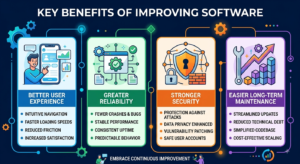
When genuine performance bottlenecks are identified and addressed, Improve Software Meetshaxs can become more responsive and efficient. The important part is measuring the problem first and evaluating the result afterward rather than assuming that every optimization will produce a meaningful improvement.
Better User Experience
Better responsiveness, clearer navigation, and fewer unnecessary interactions can make software easier to use. Since performance includes both measurable behavior and perceived experience, user experience should remain part of the optimization process.
Greater Reliability
Regular testing, monitoring, error handling, and maintenance can help teams detect and address problems systematically. A continuous improvement process also makes it easier to learn from recurring issues.
Stronger Security
Security-focused development practices help teams reduce vulnerabilities and address security concerns throughout the software life cycle. NIST specifically recommends integrating secure development practices into software development rather than treating security as a separate final activity.
Easier Long-Term Maintenance
Simpler structures, appropriate modularization, testing, dependency management, and regular maintenance can make software easier to change responsibly as requirements evolve.
Common Mistakes to Avoid When Improve Software Meetshaxs
Without a baseline, it can be difficult to determine whether a change actually solved the original problem. Performance measurement provides evidence that can guide improvement decisions.
Adding Features Without a Clear Purpose
More functionality does not automatically mean better software. New features should solve genuine problems and be evaluated for their effect on usability, performance, complexity, and maintenance.
Ignoring Security During Optimization
Security should remain part of software improvement. NIST recommends integrating secure practices into the software development life cycle, so performance work should not be separated from security considerations.
Neglecting User Feedback
Performance metrics cannot fully explain whether users can accomplish their goals easily. Feedback can reveal practical problems that technical monitoring may overlook.
Skipping Testing After Updates
Even well-intentioned changes can introduce regressions. Testing after significant changes helps verify that expected behavior remains intact and that the improvement did not create another problem.
Read more: Droven IO Tech Education Trends: AI, Digital Skills & Future Learning
How to Create a Long-Term Software Improvement Strategy
Not every issue needs to be fixed at the same time. Start by identifying the problems with the greatest impact on performance, reliability, security, or user experience.
This makes improvement more manageable and helps teams direct resources toward areas where they can create meaningful value.
Set Measurable Performance Goals
A useful goal should be measurable. Depending on the software, this might involve response time, resource consumption, error frequency, successful task completion, or another relevant metric.
The best metric depends on the problem being solved. There is no single measurement that accurately represents every software system.
Prioritize High-Value Improvements
After identifying problems, compare their expected benefits with the effort, complexity, and risk involved in fixing them.
A small change that removes a major user frustration may provide more value than a technically impressive improvement that users barely notice.
Review Results Regularly
Improvement should continue after a successful update. Performance data, user feedback, security issues, dependency changes, and maintenance needs can all provide reasons to revisit the software.
NIST’s software-development guidance supports treating secure development and improvement as ongoing activities throughout the software life cycle.
Final Verdict
To Improve software meetshaxs effectively, it is important to look beyond speed alone. High-quality software should aim to be responsive, reliable, secure, usable, maintainable, and appropriate for the needs of its users.
The 15 approaches in this guide provide a practical framework. Start by monitoring performance and identifying real bottlenecks. Then optimize resources and data, improve database operations, simplify the interface, strengthen security, introduce appropriate testing and automation, improve error handling, reduce unnecessary complexity, listen to users, and maintain the software regularly.
Most importantly, treat improvement as a continuous cycle rather than a one-time project. Measure the current situation, make a focused change, test the result, measure again, and use what you learn to decide what comes next.
FAQs About Improve Software Meetshaxs
What does it mean to improve software Meetshaxs?
It means improving software in areas such as performance, usability, reliability, security, and maintainability. The right improvements should be based on the software’s actual needs and measured results.
Why is software performance important?
Good performance helps software respond efficiently and provide a smoother user experience. Slow loading, delays, or frequent errors can make software harder and less comfortable to use.
How can software performance be measured?
Performance can be measured using response times, resource usage, loading behavior, error rates, and other relevant metrics. Monitoring and profiling can help identify areas that need improvement.
How often should software be updated?
There is no single update schedule that works for every software application. Updates should address bugs, security vulnerabilities, compatibility issues, and dependency changes when necessary.
Can improving user experience improve software performance?
Improving navigation, responsiveness, and interaction quality can make software easier and smoother to use. However, user experience and technical performance are related but remain different areas of software quality.