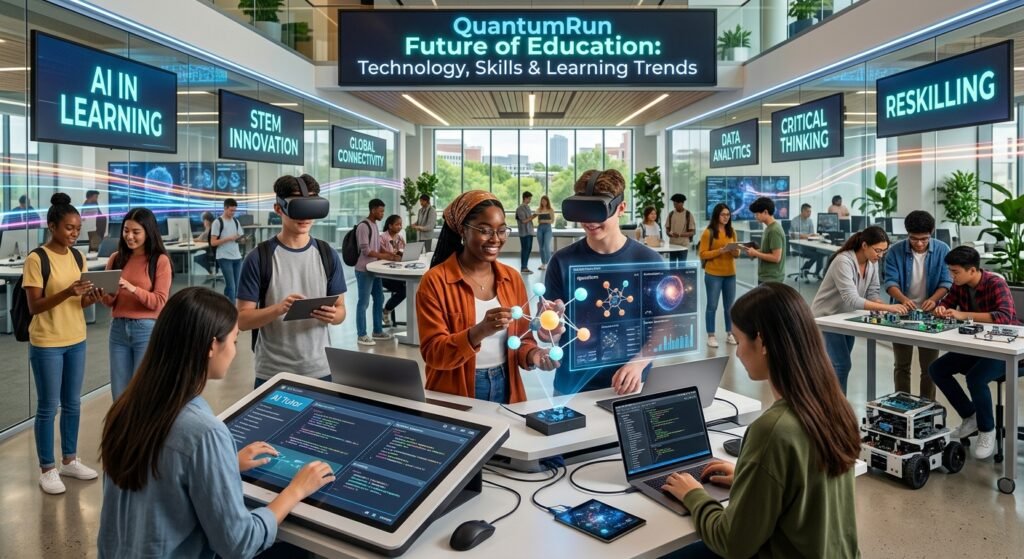

Education is changing as technology, employment, and society continue to evolve. Students are no longer preparing only for one fixed career path. They increasingly need to develop digital literacy, critical thinking, communication, creativity, problem-solving, and the ability to learn new skills throughout their lives.
QuantumRun explores these changes through foresight research, education trends, future timelines, and analysis of emerging technologies. Its education-focused material examines subjects such as artificial intelligence, digital learning, virtual reality, personalized education, changing teaching methods, and the relationship between education and future work. QuantumRun’s current education series presents these developments as areas of future change rather than guaranteed outcomes.
What Is QuantumRun and Its Vision for the Future of Education?
QuantumRun is a foresight and trend-intelligence organization that studies emerging developments and their possible future effects. Its education research covers technological, social, and economic trends that could influence teaching and learning.
Its Future of Education series includes topics such as AI-developed lesson plans, virtual reality classrooms, blended schools, changing teaching roles, and alternative approaches to educational credentials. These subjects demonstrate the breadth of its approach to future education.
Why Future Trends Matter in Education
Education takes place over many years, while technology and workplace requirements can change much faster. Students starting an educational program today may eventually enter workplaces that use tools and processes that are different from those they encountered when they began studying.
This makes adaptability increasingly important. Rather than preparing learners for only one predicted occupation, education can help them develop knowledge and transferable capabilities that remain useful across different situations.
How Technology Is Changing the Learning Environment
Digital technology is already part of modern education. Online learning platforms, digital resources, video lessons, collaborative software, and learning-management systems have expanded the ways students can access educational materials.
QuantumRun’s recent education research also examines how AI, data, immersive media, and new credentials could influence learning over the coming decade. Its 2026 education forecast describes a possible future in which education becomes more personalized, flexible, and connected to real-world work.
Major Trends Shaping the Future of Education
Changing Workforce and Career Requirements
The relationship between education and employment is becoming increasingly important. Businesses continue to adopt new technologies, which can change the skills required for particular roles.
This does not mean that every traditional occupation will disappear. Instead, many workers may need to update their skills as tools, processes, and responsibilities evolve.
Growing Importance of Lifelong Learning
Learning increasingly extends beyond formal schooling. Professional training, online courses, short programs, certifications, reading, practice, and workplace learning can all contribute to continuing education.
Lifelong learning is especially relevant when people change roles or industries. Instead of treating graduation as the end of education, learners can view it as one stage in a longer process of skill development.
Rising Demand for Adaptability
Adaptability allows people to respond when technology, job responsibilities, or market conditions change. Students can develop adaptability by learning unfamiliar tools, working on different types of projects, receiving feedback, and practicing problem-solving in situations where there is no single obvious answer.
Changing Approaches to Traditional Education
Traditional classrooms are unlikely to disappear simply because digital technologies are becoming more capable. Instead, physical instruction can increasingly work alongside online resources, digital assessments, collaborative platforms, and flexible learning options.
QuantumRun’s education forecasts include possible blended-school models in which physical and digital experiences operate together.
How Technology Is Transforming Education
Artificial Intelligence in Education
Artificial intelligence is becoming one of the most important areas of discussion in educational technology. AI tools can assist with tasks such as generating explanations, creating practice questions, organizing information, supporting writing, and providing learning assistance.
QuantumRun’s recent education forecast suggests that AI tutors and course-support systems could become much more common over the next decade. Importantly, this is a forecast about a possible future rather than a statement that every institution will adopt the same system.
AI-Powered Learning and Tutoring
AI tutoring could provide learners with additional support outside traditional classroom interactions. A digital tutor may explain a concept in another way, generate practice exercises, or help a learner identify areas that need more attention.
However, AI-generated explanations can contain errors. Students should therefore verify important information and continue to rely on teachers, textbooks, academic sources, and other appropriate evidence.
Online and Digital Learning
Online learning provides access to educational materials beyond traditional classroom schedules. It can be useful for students who need flexibility because of work, location, family responsibilities, or other circumstances.
QuantumRun has specifically examined higher-education digital experiences and reported that students increasingly expect institutions to provide strong online services.
Virtual and Immersive Learning Technologies
Virtual reality, augmented reality, and other immersive technologies may provide new ways to simulate environments and demonstrate concepts.
These technologies could be particularly useful for areas where practical experience is valuable, such as medicine, engineering, technical training, and other specialized fields. However, cost, equipment availability, content quality, and instructional design all affect their usefulness.
Data-Driven Education
Digital education systems can collect information about assignments, participation, assessments, and learning activity. Properly used, this information can help educators identify areas where students may need additional support.
At the same time, student data requires careful protection. Privacy, security, transparency, and appropriate human oversight should remain important parts of educational technology.
The Rise of Personalized and Adaptive Learning
Individual Learning Paths
Students have different backgrounds, interests, strengths, and learning needs. Personalized learning attempts to account for those differences rather than treating every learner as though they require exactly the same materials and pace. Technology can support this approach by helping organize different resources and activities for different learners.
Learning at Different Speeds
Students do not always understand a topic at the same speed. Digital systems may provide additional practice for students who need it while allowing others to move forward.
However, personalization should not eliminate collaboration. Discussion, teamwork, classroom interaction, and teacher guidance remain important parts of education.
Technology-Supported Student Progress
Digital systems can help organize information about assignments, assessments, and progress. Future systems may become better at identifying patterns and recommending learning activities.
QuantumRun’s 2026 forecast specifically discusses future learning environments in which AI and data could contribute to more personalized education.
Personalized Feedback and Support
Feedback is most useful when it helps students understand both what they did well and what they need to improve. AI tools may provide additional feedback quickly, but teachers remain important because educational judgment often requires context that automated systems cannot fully understand.
The Future Role of Teachers and Educators
Teachers as Learning Guides
Technology may change teaching responsibilities without eliminating teachers. Some repetitive activities could increasingly be supported by software, allowing educators to devote more attention to mentoring, discussion, projects, feedback, and individual student needs.
QuantumRun’s education forecasts explore this possible shift toward teachers acting more as guides and mentors rather than relying primarily on traditional lecture-based instruction.
Teachers Working With AI and Digital Tools
Teachers can use AI and other digital systems to prepare materials, develop exercises, organize information, and support students. Effective use requires training and oversight. Teachers need to understand both the benefits and limitations of the tools they use.
More Collaborative Teaching Methods
Future learning environments may combine individual study with group projects, discussion, research, practical assignments, and digital collaboration. These approaches can help students develop both subject knowledge and transferable skills.
Supporting Individual Student Needs
Technology can provide useful information about student progress, but teachers can interpret that information within the student’s broader circumstances. Human relationships, encouragement, mentoring, classroom management, and emotional support remain important aspects of education.
Blended Learning and the Future Classroom
Combining Physical and Digital Education
Blended learning combines face-to-face instruction with online or digital learning activities. It can provide flexibility while preserving direct interaction between teachers and students. QuantumRun specifically includes blended schools among the possible developments in its education forecasts.
Online Learning Within Traditional Schools
Schools and universities can use digital systems for assignments, resources, communication, assessments, and selected course activities while continuing to provide physical classes. This model can give students more flexibility without requiring institutions to abandon campuses.
Interactive and Technology-Enhanced Classrooms
Interactive technology can support demonstrations, collaboration, digital resources, and alternative forms of practice. However, technology itself does not guarantee better learning. The educational value depends on whether a tool actually improves the learning activity.
Balancing Technology With Human Interaction
More technology does not automatically produce better education. Students still benefit from teachers, classmates, discussions, teamwork, mentoring, and direct feedback. A strong future education model is likely to combine technological capabilities with human strengths.
The Importance of Real-World Learning
Projects, practical assignments, simulations, internships, and other forms of experiential learning can connect academic knowledge with real situations. They can also help students practice communication, collaboration, creativity, and problem-solving.
Essential Skills for the Future of Education
Digital Literacy
Digital literacy involves more than knowing how to operate a device. Students also need to understand how to evaluate digital information, use online tools responsibly, protect their data, and recognize limitations in technology-generated information.
Critical Thinking and Problem-Solving
Students need to evaluate evidence, identify problems, compare possible solutions, and make reasoned decisions. These abilities become especially important when AI systems can quickly generate large quantities of information.
Creativity and Innovation
Creativity helps learners develop new ideas and approach problems from different perspectives. Technology can assist creative work, but human judgment remains important when deciding what ideas are useful, appropriate, or original.
Communication and Collaboration
Students will continue to work with teachers, classmates, employers, customers, and professional teams. Communication and collaboration therefore remain valuable regardless of how advanced educational technology becomes.
Adaptability and Lifelong Learning
The ability to continue learning can become increasingly valuable when technology and job requirements change. A lifelong-learning mindset allows people to update their knowledge rather than depending entirely on skills learned early in life.
Emerging Learning Trends to Watch
Flexible and Self-Directed Learning
Flexible education allows learners to study at different times and locations. However, flexibility also creates responsibility. Students need organization, motivation, time-management skills, and discipline to succeed in self-directed environments.
Microlearning and Short Courses
Short learning formats can help people focus on specific topics or skills. They may complement longer academic programs, particularly for professional development.
Project-Based Learning
Project-based learning allows students to apply knowledge to practical tasks. Projects can also develop teamwork, research, communication, and problem-solving skills.
Experiential and Practical Learning
Practical learning connects education with real-world situations. Depending on the subject, this can include laboratories, simulations, projects, internships, fieldwork, or workplace experiences.
Continuous Skill Development
As careers evolve, people may need to update their capabilities throughout their working lives. Education can therefore become less of a one-time stage and more of an ongoing process.
How QuantumRun Can Help Explore Future Education Trends
QuantumRun provides research and foresight resources that examine emerging trends and possible future developments. Its Future of Education series provides a useful example of how technological and social changes can be considered from a long-term perspective.
Exploring Emerging Education Trends
QuantumRun’s education category includes research covering digital learning, AI, education technology, workforce changes, and other developments. Its broader platform also provides future timelines extending across multiple years, allowing users to explore possible developments rather than focusing only on current conditions.
Supporting Future-Oriented Thinking
Future-oriented thinking encourages learners to consider several possible outcomes instead of assuming that one specific future is certain. This approach can be useful for students studying technology, business, strategy, innovation, education, and career development.
Connecting Education With Long-Term Changes
Education is closely connected to changes in employment and technology. By examining these connections, students and institutions can ask better questions about which skills may remain valuable, how teaching methods could change, and how educational systems can respond to new technologies.
Benefits of Technology-Driven Education
Greater Access to Learning
Digital platforms can make educational resources available beyond traditional classroom settings. This can support students who need remote or flexible learning options, although access still depends on devices, connectivity, affordability, and digital infrastructure.
More Flexible Education
Online and blended learning can allow students to study at different times and locations. This flexibility can be valuable for working adults and other learners with responsibilities outside education.
Personalized Learning Experiences
Technology can support individualized content, feedback, and learning pathways. Personalization is most effective when it complements strong teaching rather than attempting to replace educators entirely.
Improved Student Engagement
Interactive tools, collaborative platforms, simulations, and projects can provide additional ways for students to participate. Engagement still depends on course quality, teaching methods, motivation, and meaningful learning activities.
Better Preparation for Future Careers
Technology-enabled education can help students develop digital skills while also strengthening communication, creativity, critical thinking, collaboration, and problem-solving.
Challenges Facing the Future of Education
The Digital Divide
Not every learner has equal access to reliable internet, suitable devices, or digital services. Technology-based education therefore needs to consider affordability, infrastructure, accessibility, and digital inclusion.
Privacy and Data Security
Educational technology may involve collecting information about students and their learning activities. Institutions need appropriate safeguards and transparent policies for handling student data.
Technology Dependence
Increasing reliance on technology can create difficulties when systems fail or when institutions lack adequate technical support. A resilient education system should have appropriate alternatives and human support.
Teacher Training and Support
Teachers need training to use new technologies effectively. Simply providing a new tool does not guarantee better learning. Institutions also need appropriate policies, professional development, and technical assistance.
Maintaining Human Connection
Education is a social experience as well as an academic one. Teachers, classmates, mentors, and communities provide forms of interaction that technology cannot fully reproduce.
Motivation and Self-Discipline
Flexible education provides freedom, but that freedom comes with responsibility. Students studying independently need to manage their time, maintain motivation, and complete work without constant direct supervision.
How Students Can Prepare for the Future of Learning
Develop Strong Digital Skills
Students should become comfortable with commonly used digital tools while learning how to evaluate information and use technology responsibly.
Strengthen Human and Soft Skills
Communication, teamwork, creativity, critical thinking, and problem-solving remain valuable because education and employment require more than technical knowledge.
Learn to Use AI Responsibly
AI can support learning, but students should understand its limitations. Automatically generated information should not be treated as unquestionably correct. Students should verify important claims, use appropriate sources, and follow academic-integrity rules.
Build a Lifelong Learning Mindset
Education does not have to end with graduation. Short courses, professional training, reading, practice, projects, and workplace learning can all contribute to continuing development.
Stay Adaptable to New Technologies
Students do not need to master every emerging technology. A more practical goal is to develop the confidence and learning ability needed to understand unfamiliar tools when they become relevant.
Read more: Hopkinsmedicine.org ZoomInfo: Company Profile, Contacts & Business Insights
What Could the Future of Education Look Like?
More Personalized Learning
Future education may provide more individualized learning paths supported by digital systems and AI. QuantumRun’s recent forecast describes personalization as one possible direction for education through 2036.
Greater Use of AI and Digital Tools
AI may become more integrated into tutoring, course support, content development, assessment, and learning management. The speed and scale of adoption will vary among countries, institutions, subjects, and student populations.
More Flexible Learning Models
Hybrid and online education may continue to provide alternatives to fixed classroom schedules. These models can support lifelong learning, but they also require reliable infrastructure, appropriate course design, and learner motivation.
Stronger Focus on Practical Skills
Education may place greater emphasis on applying knowledge through projects, portfolios, simulations, collaboration, and real-world activities. This does not make academic knowledge unnecessary. Instead, practical learning can complement theoretical understanding.
Education as a Lifelong Process
One of the most important long-term possibilities is that learning becomes increasingly continuous. As technologies and professional requirements change, people may need to regularly update their knowledge and capabilities.
Final Thoughts on the QuantumRun Future of Education
The future of education is unlikely to be defined by a single technology. AI, online learning, personalized education, blended classrooms, immersive technologies, and data-driven systems may all influence how learning develops. At the same time, teachers, human interaction, critical thinking, creativity, communication, and collaboration will remain important.
QuantumRun offers a useful foresight perspective because its education research examines possible long-term changes rather than presenting one guaranteed outcome. Its recent education forecast specifically considers how AI, data, immersive media, personalization, and new forms of credentials could influence learning through the next decade.
FAQs About QuantumRun
What Is QuantumRun’s View of the Future of Education?
It explores possible changes involving AI, personalized learning, digital tools, and future skills. Its forecasts describe possible developments rather than guaranteed outcomes.
How Could AI Change the Way Students Learn?
AI could provide explanations, practice materials, tutoring, and personalized support. It should complement teachers rather than replace human guidance.
What Skills Will Students Need in the Future?
Important skills include digital literacy, critical thinking, creativity, communication, collaboration, and adaptability. These skills can help learners respond to changing technology and careers.
What Are the Major Learning Trends to Watch?
Key trends include personalized learning, blended education, AI-supported learning, project-based learning, and digital education. Lifelong skill development is also becoming increasingly important.
Why Is Lifelong Learning Becoming More Important?
Technology and job requirements can change over time, making continuous learning valuable. Flexible education can help people update their knowledge and skills throughout their careers.