

Choosing the right online education degree program requires more than finding a college that offers classes over the internet. The program should match your academic background, career goals, preferred learning style, budget, schedule, and professional requirements.
Online and distance education can use technology to connect students with instructors when they are not physically together. Depending on the program, learning may include scheduled online sessions, independent coursework, discussions, assignments, assessments, and other forms of academic interaction.
Before enrolling, an online education degree is important to investigate the institution, accreditation status, curriculum, costs, admission requirements, learning format, student support, and career requirements. Taking these steps can help you compare programs based on reliable information rather than advertising claims.
What Is an Online Education Degree Program?
An online education program is a degree program in which some or all instruction is delivered through distance-learning technology. In the United States, federal guidance describes distance education as education that uses technology to deliver instruction to students who are separated from their instructors and supports regular and substantive interaction between them.
An online education can be available at different academic levels and may cover education, teaching, curriculum, educational leadership, special education, instructional design, or related subjects. The exact curriculum depends on the institution and degree.
Understanding Online Education
The phrase “online education degree” can describe many different types of programs. A bachelor’s program designed for someone entering the education field can have very different requirements from a master’s program for an experienced professional.
Some programs may focus on teaching and classroom practice, while others may emphasize educational leadership, curriculum development, learning technology, research, or administration.
How Online Degree Programs Work
Online degree programs use digital technologies to provide instruction and academic interaction. Depending on the program, students may watch or attend online lessons, read course materials, submit assignments, participate in discussions, complete assessments, and communicate with instructors.
Online learning can be synchronous or asynchronous. Synchronous activities happen at scheduled times when students and instructors interact together. Asynchronous activities allow students to participate at different times.
Identify Your Education and Career Goals
Your career goal should be one of the first things you consider when selecting an online education degree. The right program depends on what you want to do after graduation.
Start by identifying the type of work you want to pursue and then determine what education, experience, certification, or licensing may be required.
Decide Which Degree Level You Need
Online education programs may be available at undergraduate and graduate levels. The appropriate level depends on your current education and your intended career path.
If you are beginning higher education, an undergraduate program may be the logical starting point. If you already hold a bachelor’s degree and want advanced study, a master’s program may be more appropriate.
Match the Program With Your Career Plans
A degree should provide preparation that is relevant to your intended career. Review the subjects covered by the program and compare them with the knowledge and qualifications employers or professional authorities expect.
This is particularly important for regulated education careers. Completing an online education degree does not automatically give a graduate the legal authority to teach.
Consider Your Learning Preferences
Think about how you learn most effectively. Some students prefer scheduled online classes that provide a regular routine, while others prefer asynchronous coursework that gives them more control over when they study.
Consider your ability to manage independent reading, assignments, deadlines, online communication, and digital learning tools.
Check Accreditation and Program Quality
Accreditation is an important factor when evaluating an online education degree, particularly when you need the qualification for further education, professional requirements, or financial-aid purposes.
Why Accreditation Matters
Accreditation is an external quality-review process. In the United States, the Department of Education recognizes accrediting agencies but does not directly accredit individual colleges or programs.
Accreditation can provide useful information about whether an institution or program has been reviewed by an appropriate accrediting organization. Some professional fields may also have specific programmatic accreditation requirements.
How to Verify Program Accreditation
Do not rely only on an accreditation statement displayed on a college website.
For U.S. institutions, students can use official Department of Education resources to investigate institutional accreditation and recognized accrediting agencies. The Department specifically advises students to verify whether an online or distance education program is accredited.
Evaluate the Institution’s Reputation
Accreditation is important, but an online education degree should not be your only consideration.
Look at the institution’s academic information, graduation data, available student services, program requirements, costs, and other measurable information. For U.S. students, federal College Scorecard resources provide information that can help compare colleges, including costs, admissions, fields of study, and outcomes.
Compare Online Education Degree Programs
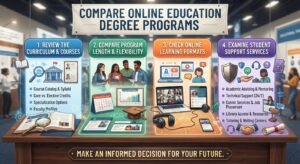
After identifying several suitable programs, compare them using the same criteria. This makes it easier to see meaningful differences between institutions.
Review the Curriculum and Courses
Read the complete curriculum before applying. Check required courses, elective options, specialization areas, practical requirements, projects, and other graduation requirements. Ask whether the subjects covered are relevant to your career plans.
Compare Program Length and Flexibility
Program length can vary depending on the degree, credit requirements, course schedule, enrollment status, transfer credits, and institutional policies.
Ask the school how many credits or courses are required and whether students can study part time. If a program advertises an accelerated completion option, find out what course load is required and whether the schedule is realistic for your circumstances.
Check Online Learning Formats
Find out exactly how the program is delivered. Some courses may be fully asynchronous, while others may require students to attend live virtual sessions at specific times. Programs may also combine online coursework with in-person activities.
Ask whether the program requires campus visits, examinations at specific locations, internships, teaching placements, clinical experiences, or other activities.
Examine Student Support Services
Online students may need many of the same academic resources available to campus students. Check whether the institution provides academic advising, technical assistance, library resources, tutoring, career services, and access to instructors.
Consider the Cost of an Online Education Degree
Cost is one of the most important factors when comparing an online education degree. The advertised tuition price does not necessarily represent the complete amount you will spend. Look at the total expected cost before making a decision.
Compare Tuition and Additional Fees
Compare tuition rates and required fees between programs. Depending on the institution, students may have additional expenses for books, course materials, technology, registration, examinations, or other requirements.
For U.S. students, federal financial-aid guidance distinguishes the broader cost of attendance from the net price a student may pay after grants and scholarships.
Explore Financial Aid and Scholarships
Financial-aid opportunities depend on the country, institution, program, and student’s eligibility. U.S. students may use the federal FAFSA process to apply for consideration for federal student aid and may also have access to institutional or private scholarships.
Students elsewhere should investigate the financial-aid systems operated by their national or regional education authorities and the institution itself. Never assume that every online student automatically qualifies for financial assistance. Check the eligibility requirements before including aid in your budget.
Calculate the Total Cost of the Program
Instead of comparing only tuition per credit, estimate the cost of completing the entire degree. Include tuition, mandatory fees, books and materials, technology expenses, and any costs associated with required in-person activities. Then consider grants and scholarships for which you are actually eligible.
Review Admission Requirements
Admission requirements vary by institution and degree level. Review them carefully before applying.
Academic Requirements
Check the minimum academic requirements for the program. Depending on the degree, an institution may require previous qualifications, prerequisite coursework, minimum grades, standardized test results, or other academic credentials.
Meeting minimum requirements does not necessarily guarantee admission, particularly when a program has a competitive selection process.
Application and Supporting Documents
Check which documents the institution requires with your application. Depending on the program, applicants may need academic transcripts, identification documents, essays, references, a résumé, test results, or other supporting materials.
Transfer Credits and Previous Education
If you have previously completed college or university coursework, ask whether those credits can be transferred.
Transfer policies vary. An institution may evaluate previous coursework based on factors such as the institution where the course was completed, course content, grades, and other academic requirements.
Read Also: How to Use Teaching Strategies GOLD Effectively in the Classroom
Consider Flexibility and Study Options
Flexibility is an important reason many students consider online education. However, an online program is not necessarily completely flexible. Each institution determines its own course schedules and academic requirements.
Self-Paced vs. Scheduled Classes
Self-paced learning gives students greater control over when they complete certain coursework, while scheduled courses require students to follow specific dates and deadlines.
Asynchronous does not necessarily mean there are no deadlines. A course can allow students to access materials at different times while still requiring assignments to be submitted by specific dates.
Balancing Study With Work and Family
If you plan to work while earning your degree, consider your available time realistically. An online education degree still requires academic work. Reading, assignments, examinations, projects, discussions, and other activities can require significant time.
Ask the institution about the expected course workload and whether part-time enrollment is available.
Understanding Attendance and Coursework Expectations
Online programs can have different expectations for academic participation. Students may be expected to submit assignments, complete assessments, participate in discussions, contribute to group activities, or engage in other academically meaningful activities.
Before enrolling, understand how your institution defines participation and what happens if you miss required activities or deadlines.
Explore Career Opportunities After Graduation
Think about career outcomes before choosing your online education degree. The degree should make sense in relation to the occupation or further education you intend to pursue.
Potential Careers in Education
Education-related degrees can support different career directions depending on the program and the qualifications you earn.
Possible areas can include teaching, educational administration, curriculum development, training, instructional design, educational support, or further academic study.
Teaching Licensure and Certification
Students who want to become teachers should investigate licensing requirements before selecting a degree.
Teacher certification is generally governed by the relevant education authority rather than simply by the university that awards the degree.
In the United States, teacher certification requirements are established by individual states, so requirements can differ from one state to another.
Further Education and Professional Development
An online education degree may also provide a pathway to further study, depending on the degree level and the admission requirements of the next program.
If you plan to pursue a master’s, doctoral, professional, or specialist qualification later, check whether your chosen degree will satisfy the relevant admission requirements.
Professional development can also involve certifications, continuing education, practical experience, or other learning opportunities depending on your career.
Evaluate the Benefits and Challenges
Online education has potential advantages, but it also requires students to manage responsibilities independently. Understanding both sides can help you decide whether an online education degree is appropriate for you.
Benefits of Earning a Degree Online
Online education can provide access to degree programs without requiring students to attend traditional classroom sessions for every course.
The online format can also provide different scheduling options, depending on how the institution structures online education degree courses.
For students who work or have other responsibilities, a program with asynchronous or part-time options may make higher education easier to fit into an existing schedule.
Common Challenges of Online Learning
Online learning requires students to manage coursework through digital systems and maintain communication with instructors and classmates. Students may need to organize their own study time, meet deadlines, participate in online activities, and resolve technical issues when they occur.
Programs that include scheduled classes or practical requirements can also create additional scheduling considerations.
Tips for Staying Organized and Motivated
Create a regular study routine and keep track of every assignment, examination, project, and deadline. Break larger assignments into smaller tasks and avoid leaving important work until the last minute.
Use academic advising, instructor communication, technical support, library resources, and other services offered by your institution when you need assistance.
Most importantly, treat online study as a real academic commitment rather than assuming that studying from home requires less effort.
How to Choose the Right Online Education Degree Program
Choosing the right program becomes easier when you use a consistent evaluation process. Rather than selecting a school because of one attractive feature, compare the complete academic and financial picture.
Create a List of Your Priorities
Start with your essential requirements.
Your list might include:
- Appropriate degree level
- Relevant curriculum
- Recognized accreditation
- Affordable total cost
- Flexible course schedule
- Suitable learning format
- Student support
- Transfer-credit policies
- Career alignment
- Professional licensing requirements
Separate essential requirements from features that would simply be convenient.
Compare Several Programs Side by Side
Choose several programs that meet your basic requirements and compare them using the same criteria.
Record information about tuition, fees, accreditation, curriculum, course format, program length, admission requirements, financial aid, student services, and career-related requirements.
A simple comparison table can help you identify differences that may not be obvious when looking at programs separately.
Check Costs, Accreditation, and Career Outcomes
Before making a final decision, verify the most important information. Check accreditation through appropriate official sources, confirm the complete cost with the institution, and investigate the professional requirements associated with your intended career.
For U.S. programs, federal resources can provide information about accreditation, college costs, admissions, fields of study, and outcomes.
Make an Informed Final Decision
The right online education degree is not necessarily the cheapest or fastest program. A better choice is usually the program that provides a sensible combination of academic quality, recognized accreditation, relevant coursework, manageable cost, appropriate flexibility, student support, and a realistic connection to your career goals.
Final Thoughts
Choosing the right online education degree requires careful research rather than a quick comparison of tuition prices. Start by identifying your career and education goals. Then evaluate the degree level, curriculum, accreditation, cost, admission requirements, learning format, flexibility, student support, and professional requirements.
Pay particular attention to accreditation and licensing if your chosen career is regulated. Verify important information through official sources and ask the institution directly about requirements that could affect your eligibility, cost, or graduation timeline.
FAQs about Online Education Degree
Is an online education degree worth it?
An online education degree can be worthwhile when it is accredited or properly recognized, affordable, relevant to your goals, and suited to your learning needs.
Compare the curriculum, total cost, completion requirements, and career opportunities before choosing a program.
How long does an online education take?
The time required varies based on the degree level, coursework, enrollment status, transfer credits, and the institution’s academic structure. Check the program’s official requirements to understand its expected completion timeline.
Are online education degrees accredited?
Some online education are accredited, while others may not be, so students should verify the institution and program’s accreditation status. In the United States, accreditation information can be checked through recognized higher-education accreditation resources.
Can I work while earning an online education?
Many online programs offer scheduling options that can make studying while working possible, depending on the course structure. Check class times, assignment deadlines, examinations, and practical requirements before enrolling.
Can an online education degree lead to a teaching career?
It can support a pathway into teaching, but completing the degree does not automatically provide a teaching license. Teaching requirements vary by jurisdiction, so check the rules where you plan to work before choosing a program.