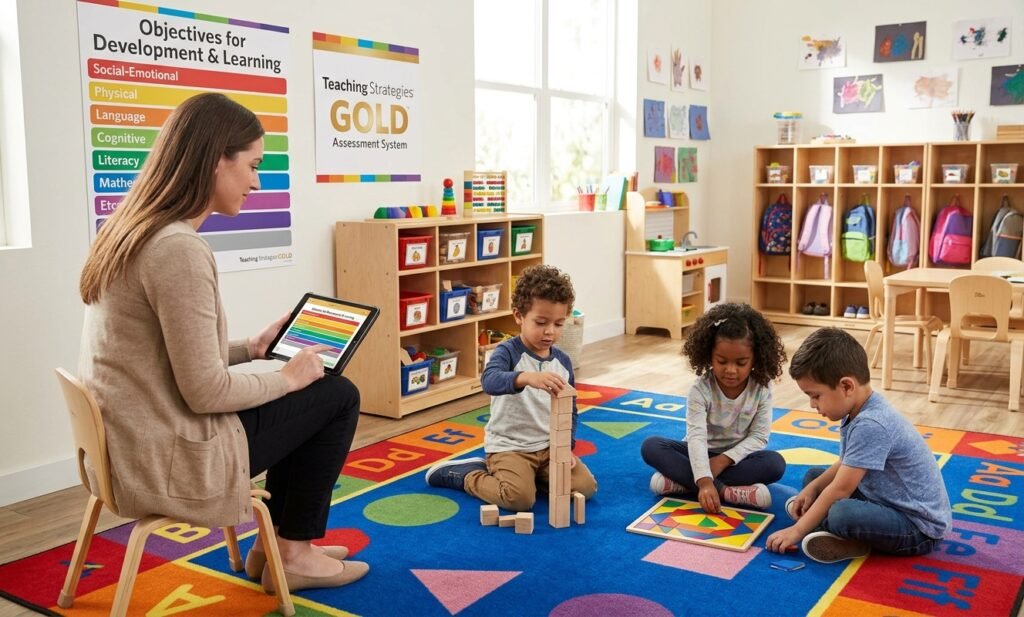

Understanding how young children learn requires more than looking at whether they can complete a worksheet or answer a question correctly. Teachers need to notice what children do during real classroom experiences, understand what those behaviors reveal about development, and use that information to decide what to teach next. Teaching Strategies GOLD is an observation-based formative assessment system designed to help educators document and understand children’s development and learning. It is built around 38 Objectives for Development & Learning and is currently designed for children from birth through third grade.
The most effective way to use teaching strategies is to make observation part of everyday teaching rather than treating assessment as a separate task. When teachers collect meaningful evidence, review it carefully, and connect it to instructional decisions, assessment can become a practical part of supporting each child’s learning.
What Are Teaching Strategies GOLD?
It is an ongoing, observation-based assessment system. Instead of depending only on a single test or assessment session, it allows teachers to collect evidence of children’s knowledge, skills, and behaviors during authentic classroom experiences. Teachers can document learning in several ways, including written notes, photographs, videos, and digital samples of children’s work. These records can then be organized and connected to the objectives used within the GOLD framework.
The system is organized around 38 Objectives for Development & Learning. These objectives cover major areas of children’s development and learning and provide a framework for understanding what children know and can do as they progress over time.
The Purpose of Teaching Strategies GOLD
The purpose of Teaching Strategies GOLD is closely connected to formative assessment. Teachers collect information about children’s learning, examine that information, and use it to make instructional decisions.
Teaching Strategies describes GOLD as a tool for authentic, ongoing assessment that can be embedded into everyday interactions. The system is intended to help educators understand individual children’s needs, inform instruction, document progress, and strengthen communication with families.
It is important not to misunderstand what the system is designed to do. Teaching Strategies’ technical materials distinguish GOLD from screening, diagnostic assessment, and traditional achievement testing. In other words, teachers should use the evidence gathered through GOLD to understand and support learning rather than treating it as a medical or diagnostic evaluation.
How It Supports Early Childhood Learning
Young children often demonstrate important skills while they are playing, talking, exploring, creating, solving problems, and interacting with other people. Observation allows teachers to see those skills in the context where they naturally occur.
The GOLD objectives provide a framework for understanding children’s development across multiple areas. Because observations can be collected during different classroom experiences, teachers can build a broader picture of a child’s learning instead of relying on one isolated performance.
For example, a child building with blocks may demonstrate more than construction skills. The teacher may also notice problem-solving, communication, cooperation, counting, spatial thinking, persistence, or fine-motor skills. A well-documented observation can capture several aspects of learning without interrupting the child’s activity.
Why Use Teaching Strategies GOLD in the Classroom?
Supporting Individual Child Development
Every child brings different experiences, interests, strengths, and developmental needs to the classroom. A useful assessment system should help teachers notice those differences rather than treating the class as if every child learns in exactly the same way. Teaching Strategies GOLD is designed to help educators understand individual children’s development and use assessment information to support individualized instruction.
For teachers, this can make assessment more practical. Instead of asking only whether the class has learned a particular concept, the teacher can look at what each child is demonstrating and consider what kind of support or learning opportunity may be appropriate next.
Tracking Learning and Development Over Time
A single observation provides only a snapshot. Children’s abilities can look different depending on the activity, environment, materials, and people involved. Ongoing documentation gives teachers more opportunities to see patterns in children’s learning. Teaching Strategies recommends collecting documentation across different settings and using multiple forms of evidence to develop a fuller understanding of children’s skills and knowledge.
For example, a child may show strong communication skills during dramatic play but participate less during a large-group discussion. Looking at observations from both settings gives the teacher more information than either observation alone.
Improving Classroom Planning
Assessment becomes valuable when teaching strategies gold influences what happens next. Teaching Strategies presents GOLD as a system that connects observation-based assessment with instruction. Teachers can use information from observations to identify children’s current strengths, recognize areas that may need additional support, and plan learning experiences that respond to those observations.
This means a teacher does not have to create lesson plans independently of assessment. Instead, observations can become one source of information that helps shape future classroom experiences.
Supporting Communication With Families
Families see parts of a child’s development that teachers may not see at school, so communication can add important context to assessment. Teaching Strategies allows family observations to be incorporated into GOLD documentation. The company also describes GOLD as supporting communication with families through information about children’s development and learning.
Specific evidence can make these conversations more useful. Rather than telling a family only that a child is “doing well,” a teacher can discuss a particular classroom experience and explain what the child demonstrated during teaching strategies gold.
How Teaching Strategies GOLD Works
Observing Children During Everyday Activities
Observation is central to Teaching Strategies GOLD. Teachers can gather evidence while children participate in ordinary classroom experiences such as choice time, outdoor play, routines, transitions, small-group activities, and conversations. Teaching Strategies recommends collecting documentation across different settings because children may demonstrate their knowledge and skills differently depending on the context.
The goal is not to watch every child constantly. Instead, teachers can plan purposeful observations and pay attention to moments that provide meaningful evidence of learning.
Documenting Evidence of Learning
A useful observation should tell a clear story about what happened. Teaching Strategies recommends documentation that includes meaningful details about what the child said and did, along with enough context to understand the learning taking place. Examples can include notes, exact quotes, photographs, videos, and work samples. Consider the difference between these two notes:
Weak observation:
“Maria is good at counting.”
Stronger observation:
“Maria counted 12 blocks one at a time, touching each block as she said the number. When she reached 10, she continued with 11 and 12 without assistance.”
The second example provides observable evidence that a teacher can interpret and connect with an appropriate learning objective.
Connecting Observations to Learning Objectives
Documentation becomes more useful when teachers connect it to the appropriate objectives. Teaching Strategies GOLD uses 38 Objectives for Development & Learning as its framework for understanding children’s knowledge, skills, and behaviors.
Teachers can therefore move from a simple description of an activity to a more meaningful assessment question: What does this observation tell me about the child’s current learning and development?
This connection also helps teachers avoid collecting documentation simply for the sake of having a large number of records.
Reviewing Children’s Progress
Documentation should eventually lead to reflection. Teachers can review collected observations, consider what the evidence shows, and determine whether a child is demonstrating a developing skill consistently or only in particular situations. Teaching Strategies describes an ongoing process of observing, analyzing, evaluating, and responding to children’s learning.
The review stage is important because documentation by itself does not improve instruction. Its value comes from what teachers do with the information.
How to Use Teaching Strategies GOLD Effectively
Make Observation Part of the Daily Routine
One of the simplest ways to make teaching strategies gold manageable is to integrate observation into the normal classroom routine. Teachers can intentionally focus on a small number of children during different parts of the day and rotate those observations over time. Teaching Strategies recommends planning observations across settings and focusing on quality rather than simply collecting large quantities of documentation.
For example, a teacher might focus on one group during center time, another during outdoor play, and another during a transition or small-group activity. This approach can make observation feel like part of teaching instead of an additional task added to the end of the day.
Collect Meaningful Learning Evidence
More documentation is not necessarily better documentation. A useful piece of evidence should provide information that helps the teacher understand what the child knows or can do. Teaching Strategies describes high-quality documentation as rich, meaningful, and useful: teaching strategies provide context, connect with learning objectives, and can inform instructional decisions. A short, specific observation can therefore be more valuable than several vague notes.
Record Objective and Accurate Observations
Teachers should distinguish between what they actually observe and what they assume about a child. Instead of writing, “James was frustrated and does not understand the activity,” a more objective observation might describe what happened: “James pushed the puzzle away after trying three pieces and said, ‘I can’t do it.'”
The second description gives the teacher evidence without assuming why the child behaved that way. Teaching Strategies emphasizes detailed observation that captures children’s actual words and actions.
Use Observations to Guide Instruction
The real value of teaching strategies gold appears when observations influence teaching. Suppose a teacher notices that several children can recognize individual numbers but have difficulty connecting numbers with quantities. That information can influence the teacher’s next learning experiences.
The teacher might provide additional opportunities to count objects, compare quantities, match numerals with groups of objects, or explore mathematical ideas through play. The exact response should depend on what the evidence shows. Teaching Strategies describes GOLD as supporting differentiated instruction and connecting assessment with instruction.
Review Progress Regularly
Assessment should be an ongoing process rather than something completed only at the end of a reporting period. Regularly reviewing documentation helps teachers notice whether children are developing skills, demonstrating them in new settings, or needing additional opportunities to practice.
Teaching Strategies’ current documentation guidance describes an ongoing cycle of Observe, Analyze, Evaluate, and Respond, emphasizing that documentation should directly influence teaching decisions.
Teaching Strategies GOLD for Getting Better Results
Use Play-Based Learning Opportunities
Play can provide rich opportunities for teachers to observe children’s learning naturally. During block building, dramatic play, games, art, outdoor exploration, or other child-directed activities, children may demonstrate communication, problem-solving, social interaction, mathematical thinking, creativity, and persistence.
Teaching Strategies specifically recommends following children’s lead and observing them when they are engaged because authentic activities can reveal skills and knowledge that may not appear when children are simply asked to demonstrate a skill for the teacher.
Encourage Exploration and Problem-Solving
Teachers can create classroom experiences that give children opportunities to investigate, make choices, try different approaches, and solve problems. For example, rather than immediately showing a child how to make a structure stand, a teacher might provide materials and allow the child to experiment. The teacher can observe how the child approaches the problem, responds to failure, communicates ideas, and changes strategies.
Support Language and Communication
Language development happens throughout the day. Teachers can observe children while they talk with classmates, explain their ideas, participate in dramatic play, respond to questions, tell stories, or describe their work.
Language is one of the developmental areas represented within the GOLD framework, and the objectives also include an area addressing English language acquisition. Rather than limiting language observation to a formal lesson, teachers can use everyday conversations as opportunities to notice communication skills.
Develop Social-Emotional Skills
Children demonstrate social and emotional skills during ordinary classroom interactions. A teacher might observe how a child enters a group activity, responds to a peer, manages emotions, follows classroom routines, or seeks assistance from an adult. Social-emotional development is one of the major areas included in the GOLD objectives.
Adapt Activities to Individual Needs
The same activity can sometimes be adjusted to provide different levels of support. One child may need modeling or additional prompts, while another may be ready for a more challenging variation of the same task. Assessment information can help teachers make those decisions. Teaching Strategies GOLD as supporting individualized instruction and differentiated learning based on information about children’s development.
How to Use Assessment Information for Lesson Planning
Identify Children’s Strengths
Effective planning begins with knowing what children can already do. When teachers review documentation, they can identify skills that children demonstrate confidently as well as interests that appear repeatedly in their play and interactions. Those strengths can become starting points for extending learning. A child who enjoys building, for example, may be especially engaged by opportunities that introduce measurement, shapes, spatial relationships, or collaborative problem-solving.
Recognize Areas for Additional Support
Assessment can also help teachers notice where additional support may be appropriate. The important point is to look for patterns rather than making a decision from one isolated observation. Several observations from different settings can provide stronger information about a developing skill. Teaching Strategies recommends collecting documentation across settings to gain a fuller understanding of children’s abilities.
Plan Appropriate Learning Experiences
Once teachers understand the evidence, they can choose learning experiences that connect with children’s current development. For instance, if observations show that children are beginning to recognize letters but need more opportunities to connect letters with sounds, a teacher can incorporate appropriate literacy experiences into small groups, games, dramatic play, or other classroom activities.
Adjust Teaching Strategies Based on Progress
Planning should remain flexible. After introducing a learning experience, teachers can observe how children respond. If the activity is too difficult, additional support may be appropriate. If children demonstrate the skill confidently, the teacher may provide an opportunity that extends their learning.
Common Mistakes When Using Teaching Strategies GOLD
Relying on Limited Observations
One observation should not automatically define what a child can or cannot do. Children may demonstrate different abilities in different situations. A child who is quiet during group time may communicate extensively during dramatic play, for example. Collecting evidence across classroom settings gives teachers more opportunities to see different aspects of children’s development.
Confusing Opinions With Evidence
Statements such as “He is lazy,” “She is very smart,” or “He is bad at math” are judgments rather than useful documentation. A stronger record describes observable behavior. Teachers can then interpret that evidence in relation to the appropriate objective.
Treating Assessment as a One-Time Task
Teaching Strategies GOLD is designed around ongoing observation and formative assessment. Trying to collect most of the evidence at one time can provide a narrower picture of children’s learning. Regular documentation allows teachers to gather evidence across different activities and circumstances.
Using the Same Approach for Every Child
A classroom can have shared learning goals while children receive different types or amounts of support. GOLD’s objectives and developmental progressions are intended to help educators understand individual children’s development and use that information to inform instruction. Teachers should therefore use assessment information to make instruction responsive rather than assuming one strategy will work equally well for everyone.
Best Practices for Teaching Strategies GOLD
Keep Documentation Consistent
Consistency does not mean documenting everything. A manageable routine can be more effective. Teachers can plan which children they want to observe, vary the classroom settings, and use different forms of documentation depending on the situation.
Collaborate With Other Educators
Teachers do not have to interpret every piece of assessment information alone. Discussing observations with colleagues can provide another perspective and help educators think more carefully about what the evidence shows. Teaching Strategies also provides professional development focused on strengthening educators’ assessment skills and reliability when using GOLD.
Review Assessment Information Regularly
Documentation is most useful when teachers actually use it. Set aside time to review recent observations and ask practical questions:
- What is this child demonstrating?
- What patterns am I seeing?
- Which skills are emerging?
- What learning experience could support the next step?
- Do I need more evidence before making an assessment decision?
This kind of reflection keeps documentation connected to teaching.
Involve Families in the Learning Process
Families can contribute valuable information about children’s experiences outside the classroom. Teaching Strategies supports the integration of family observations into GOLD documentation. Teachers can use family conversations to learn about children’s interests, experiences, and behaviors in other environments while also sharing meaningful classroom observations with families.
Focus on Individual Progress
The purpose of assessment should not be reduced to comparing one child with another. Teaching Strategies GOLD provides objectives and developmental progressions that help educators understand children’s development over time. A stronger question is often, “What is this child demonstrating now, and what learning opportunity could help support continued development?”
Read more: Robthecoins Business Tips: Smart Ways to Grow and Manage a Business
Final Thoughts on Using Teaching Strategies GOLD Effectively
Using teaching strategies effectively is less about collecting the largest possible number of observations and more about collecting the right evidence and doing something useful with it. A practical approach is to observe children during authentic classroom experiences, document specific behaviors and words, connect the evidence with appropriate learning objectives, review progress, and use what you discover to guide future teaching. Teaching Strategies’ current guidance similarly emphasizes an ongoing cycle of observing, analyzing, evaluating, and responding.
Teachers should also remember that assessment is only one part of good teaching. The value of GOLD comes from how educators use the information to understand individual children, plan meaningful learning opportunities, communicate with families, and respond to developing skills.
FAQs About Teaching Strategies GOLD
What is Teaching Strategies GOLD used for?
It is used to observe, document, and assess children’s development and learning. It helps teachers understand progress and plan appropriate learning experiences.
How does it help teachers?
It helps teachers organize observations and identify children’s strengths and areas for growth. Teachers can use this information to make informed instructional decisions.
How often should teachers use Teaching Strategies GOLD?
It is designed to be used as an ongoing assessment process, not a one-time task. Regular observations help teachers understand children’s development over time.
What type of evidence can teachers document in Teaching Strategies GOLD?
Teachers can document learning through observation notes, photos, videos, and work samples. Evidence can be collected during everyday activities, routines, play, and classroom interactions.
How can it support individual learning needs?
Teachers can use assessment information to understand each child’s skills, interests, and needs. This helps them adapt activities and provide more individualized learning opportunities.