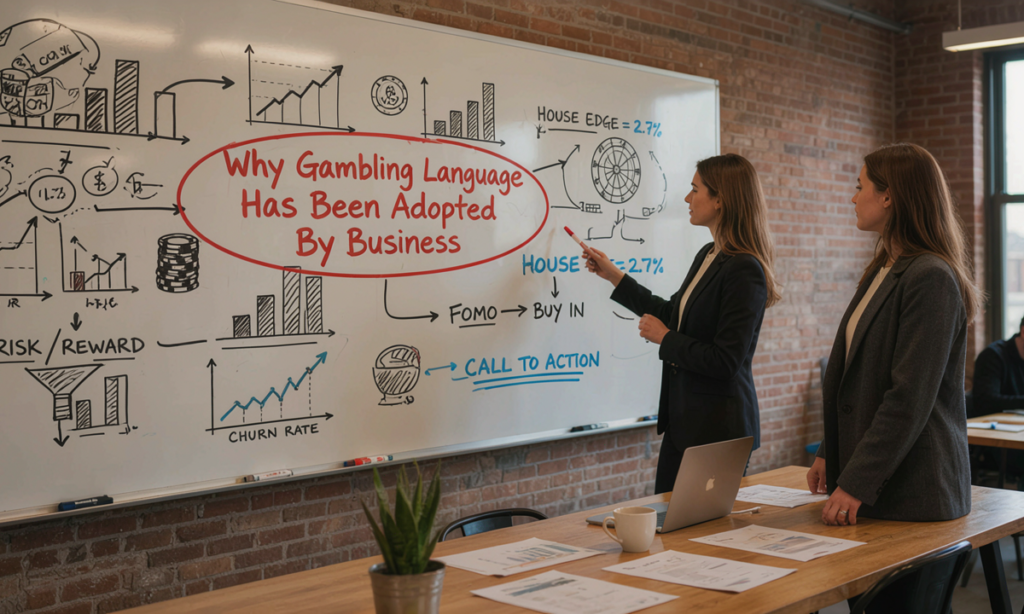

“Raise the stakes.” “Bet on the idea.” “Play your cards right.” “Go all in.” Business writing is full of phrases that came from gambling, cards, and games of chance.
Most speakers do not mean these words literally. A founder who goes “all in” may invest time and money in a new company. An investor who “bets on” a team expects it to succeed. A manager who “plays it safe” chooses a less risky plan.
The language fits because business involves choices made without complete information. A company can study its market, test a product, and build a detailed forecast. It still cannot know exactly what customers, competitors, or the economy will do next.
Startup culture makes this uncertainty more visible. Young firms often work with limited cash, small teams, and untested products. One decision can change their path. A new hire may speed up growth or strain the budget. A product launch may find a market or fail to gain attention.
Gambling metaphors turn these complex situations into simple mental pictures. People understand what it means to put something valuable at risk when the result remains unknown.
That makes the language short, vivid, and easy to remember. In fast-moving business conversations, those qualities help explain uncertainty without a page of technical terms.
Risk Metaphors Turn Uncertainty Into A Clear Picture
Business decisions often involve facts, forecasts, and unknowns at the same time. That mix can be hard to explain. Risk metaphors make it easier by turning an uncertain choice into something people can picture.
Consider a startup deciding whether to launch a new product. The team has research. It has a budget and a deadline. Yet no spreadsheet can prove how customers will react. Calling the launch a “bet” quickly signals that the company must act before it knows the result.
The same pattern appears in business writing. An article on this website, for example, might describe a founder as “doubling down” on a strategy after early success. Readers do not need a lesson on the phrase. They understand that the founder is committing more resources to the same plan.
Other expressions work in similar ways. “Raise the stakes” means that a decision now carries greater consequences. “Play your cards right” points to careful timing and smart choices. “Hedge your bets” suggests keeping several options open.
These phrases work because they replace vague ideas with actions. Readers can picture a card being played or a stake being raised.
The metaphor does not explain the whole decision. It does something more basic. It gives uncertainty a shape, which helps readers grasp the situation before they examine the details.
Startup Culture Makes The Metaphor Even Stronger
Startups face a type of uncertainty that makes risk language feel natural. A new company often has limited cash, little history, and no guaranteed market. Its team must make important choices before all the facts are available.
A founder may spend months building a product that customers have never used. An investor may fund a team before the company earns steady revenue. A startup may hire ten people because it expects demand to rise. Each decision puts real resources behind an expected result.
This is why founders often talk about bets. The word turns a complex business choice into a simple structure: something has value, the future is uncertain, and a decision must happen now.
Yet a business bet differs from pure chance. Teams can collect data, interview customers, test prototypes, and change direction. They can reduce uncertainty before committing more money.
That distinction explains another common phrase: “double down.” In startup language, it often means putting more resources behind an approach that has already shown promising results.
The metaphor works because startups rarely move in a straight line. Teams test one route, study what happens, and choose the next move. Risk language captures that process in a few familiar words.
Investors Also Speak In The Language Of Bets
Investment adds another layer to business risk. Investors study revenue, costs, markets, and management teams. They can build detailed models. Yet they still make decisions about a future that no one can see.
This helps explain phrases such as “betting on a founder” or “backing a winner.” The investor is not describing a game. The words show that money is being committed based on evidence, judgment, and an expected result.
The metaphor becomes especially useful with early-stage companies. A young startup may have little revenue and a short track record. Investors must judge its team, product, market, and growth potential with limited evidence.
They can reduce uncertainty through research. They can compare competitors, inspect financial records, and test assumptions. They can also spread capital across several companies rather than depend on one outcome.
This is where gambling language has limits. Investment risk can often be studied, measured, and managed. A metaphor such as “placing a bet” captures the uncertainty, but it can hide the work behind the decision.
Good business writing keeps that difference clear. The phrase creates a quick picture. The details explain why someone decided that a particular risk was worth taking.
Business Media Helps Keep The Language Alive
Business language spreads through more than office meetings. News reports, podcasts, newsletters, and social posts repeat the same phrases until they become part of everyday speech.
A headline may say that a company is “doubling down” on artificial intelligence. A founder may tell a podcast host that investors “bet on the team.” A market report may describe a product launch as a “high-stakes move.” Readers soon learn these phrases without thinking about their original setting.
The language works well in media because it is compact. “Raise the stakes” is shorter and sharper than explaining that a decision has increased both the possible reward and the cost of failure.
Writers also use these metaphors to add movement. Business stories can involve dry subjects such as budgets, forecasts, and market share. A familiar risk phrase can make the situation easier to picture.
But strong writing still needs detail. Saying that a company “went all in” tells readers little on its own. Did it hire more staff? Spend more on research? Enter a new market? The writer should show the concrete action behind the phrase.
Used this way, gambling language acts as shorthand rather than evidence. It catches the idea quickly. Facts then give that idea weight.
The Metaphor Works Best When The Facts Stay Visible
Gambling language survives in business because it makes uncertainty easy to describe. But a metaphor works best when it points to a real decision rather than replacing the details.
Take the phrase “high-stakes move.” It tells readers that a choice matters. It does not explain what the company could gain or lose. A useful account should name the money, jobs, market share, time, or reputation involved.
The same rule applies to “safe bet.” Few business choices are truly safe. Demand can fall. Costs can rise. A competitor can launch a better product. Clear writing should show why a choice appears less risky instead of treating success as certain.
This matters because business risk is often measurable. Teams can test demand, compare costs, study past results, and set limits on spending. These steps turn a vague risk into a decision that people can examine.
Metaphors should therefore open the door, not fill the room. They give readers a fast mental picture. Concrete facts provide the scale and meaning.
That balance keeps business language lively without making it loose. A sharp phrase catches attention. Precise details tell readers what is actually at stake.
Why The Language Is Likely To Stay
Business vocabulary changes as industries change. New technology creates new terms. Management trends come and go. Yet phrases built around bets, odds, stakes, and cards have lasted because they describe a basic part of business: making choices before the outcome is known.
A founder can gather customer data but cannot predict every sale. An investor can study a company but cannot see its future. A manager can build a careful plan and still face an unexpected competitor. In each case, information reduces uncertainty but does not erase it.
Gambling metaphors give that uncertainty a simple shape. “Going all in” describes commitment. “Hedging a bet” suggests protection. “Raising the stakes” signals greater consequences. These phrases work because readers understand the basic image at once.
Their value, however, comes from compression rather than precision. A metaphor can introduce an idea. It cannot replace numbers, evidence, or a clear account of what happened.
That distinction explains why risk language fits business and startup culture so well. Business is not a game of pure chance, but it always contains unknowns. As long as people must make decisions before they know the result, they will need simple language to describe that tension.