
Opening a business bank account is an important step for managing company finances, organizing transactions, and keeping business and personal money separate. For businesses considering a US Bank business account, understanding the available account types, requirements, fees, transaction limits, and banking features can make the process easier.
The U.S. Bank currently offers several business banking options, including checking, savings, money market accounts, certificates of deposit (CDs), and nonprofit checking. The right option depends on factors such as transaction volume, cash-flow needs, average balances, business structure, and how much access the business needs to its funds.
What Is the U.S. Bank Business Account?

A US Bank business account is a deposit account designed for businesses and organizations to manage business-related money. Depending on the account, it can be used for receiving payments, paying expenses, transferring money, saving operating reserves, and managing everyday cash flow.
The U.S. Bank offers different business deposit products rather than one single account for every type of company. Checking accounts are generally designed for day-to-day transactions, while savings, money market accounts, and CDs can be used for funds that a business does not need for immediate operating expenses.
How a U.S. Bank Business Account Works
Once a business account is opened, the business can use the account according to the product’s terms. U.S. Bank business checking accounts include online banking, bill pay, money movement capabilities, and a U.S. Bank Visa Business Debit Card. US Bank Business Account also provides tools for cash-flow monitoring and integrations with certain third-party accounting, budgeting, and tax programs. The exact features, fees, transaction allowances, and requirements depend on the account selected.
Business Banking vs. Personal Banking
A business account is intended for business activity, while a personal bank account is designed for an individual’s personal finances. Keeping business revenue and expenses in a dedicated account can make bookkeeping and tax preparation easier.
The U.S. Bank specifically notes that maintaining separate accounts can be important for LLCs and corporations because mixing business and personal funds can potentially affect liability protection.
Why Businesses Use a Separate Bank Account
A separate business account can help an owner track revenue, operating expenses, payroll-related payments, vendor payments, and other business transactions without mixing them with personal spending. It can also make financial records easier to review and give a business a clearer picture of its cash flow.
What Types of Business Accounts Does U.S. Bank Offer?
A US Bank business account can refer to several different deposit products. Each serves a different financial purpose.
Business Checking Accounts
Business checking accounts are designed primarily for regular business activity. The U.S. Bank currently offers Business Essentials, Gold Business Checking, Platinum Business Checking, Premium Business Checking, and a Nonprofit Checking Account.
Business Savings Accounts
U.S. Bank offers Basic Business Savings and Business Savings Sweep options. Basic Business Savings is intended for businesses that want to set aside money while retaining online access to their funds. The Business Savings Sweep account can automatically move excess balances from a connected U.S. Bank business checking account into savings according to the account’s setup.
Business Money Market Accounts
U.S. Bank offers Platinum, Preferred, and Premium Business Money Market accounts. These accounts are designed for businesses that want to earn interest while retaining access to funds. Rates can vary by account balance and location.
Business Certificates of Deposit (CDs)
Business CDs allow a company to place funds into a certificate for a specified term. US Bank Business Account currently lists several business CD options, including Standard, Special, Jumbo, Step Up, and Trade Up CDs.
Terms vary by product, and minimum opening deposits range from $500 for the Standard CD to higher amounts for certain specialized products. Early withdrawals may result in a penalty.
Nonprofit Business Checking
The U.S. Bank also offers a Nonprofit Checking Account. The current account has a $0 monthly maintenance fee and includes 1,800 free transactions per calendar year, with a $0.50 fee for each additional transaction.
U.S. Bank Business Checking Account Options
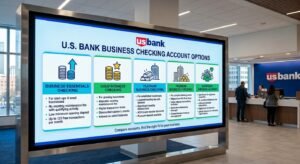
Choosing a US Bank business account often starts with selecting the checking account that matches the company’s transaction volume and financial activity.
Business Essentials
U.S. Bank Business Essentials currently has a $0 monthly maintenance fee. It includes unlimited digital transactions and 25 free teller and paper transactions per statement cycle.
The account also includes a free mobile card reader with a $0 software fee and free same-day access to funds subject to applicable terms. The minimum opening deposit is $25.
Gold Business Checking
Gold Business Checking currently has a $20 monthly maintenance fee, which can be waived when specified requirements are met.
It includes 350 free transactions per statement cycle. Additional transactions are currently charged at $0.45 each. The U.S. Bank lists several ways to qualify for the maintenance-fee waiver, including qualifying balances, certain combined balances, or U.S. Bank Payment Solutions.
Platinum Business Checking
Platinum Business Checking currently has a $30 monthly maintenance fee, with waiver options for qualifying businesses.
The account includes 550 free transactions per statement cycle, with a $0.40 fee for each additional transaction. Current fee-waiver options include US Bank Business Account Payment Solutions, a $25,000 average collected checking balance, or qualifying combined balances.
Premium Business Checking
Premium Business Checking currently carries a $34 monthly maintenance fee. Instead of a standard transaction allowance being presented as the primary pricing feature, U.S. Bank describes this account as using an earnings credit calculated from the account balance to offset account fees.
This type of structure may be relevant to businesses with larger balances and more complex banking activity.
Nonprofit Checking Account
The Nonprofit Checking Account currently has no monthly maintenance fee. It includes 1,800 free transactions per calendar year and charges $0.50 for each additional transaction.
Key Features of U.S. Bank Business Accounts
The value of a US Bank business account is not limited to the deposit account itself. U.S. Bank provides several digital and financial-management tools alongside its business banking products.
Online and Mobile Banking
U.S. Bank business customers can manage money through online and mobile banking. The bank states that customers can move money to and from checking accounts using desktop, tablet, or mobile devices.
Money Transfers and Bill Payments
Business banking customers can transfer money between eligible accounts and use business bill pay to review, track, and pay bills.
Mobile Check Deposit
The U.S. Bank includes mobile check deposit among qualifying transactions for certain current account promotions, and its business savings information also identifies mobile check deposit as an available digital banking capability.
Business Debit Card Access
Every US Bank Business Account checking account includes a U.S. Bank Visa Business Debit Card, according to the bank’s current business checking information.
Accounting and Business Software Integration
The U.S. Bank provides integration options with third-party accounting, budgeting, and tax programs. These integrations can give business owners a more centralized view of financial information.
Cash Flow Monitoring
U.S. Bank’s business banking dashboard includes cash-flow monitoring tools intended to help businesses forecast and plan ahead.
Fraud Protection and Security Tools
U.S. Bank promotes fraud-prevention tools as part of its business banking services. Its business money market information also describes fraud protection and tools designed to help protect business and payment information.
U.S. Bank Business Account Requirements
The exact requirements for a US Bank business account depend on the business structure and account selected.
Personal Information You May Need
For an online business checking application, U.S. Bank states that each applicant must provide information such as a Social Security number or Individual Taxpayer Identification Number, legal name, home address, email address, and mobile number.
Business Tax Identification Number
The business generally needs to provide a business Taxpayer Identification Number. U.S. Bank notes that sole proprietors may use the owner’s Social Security number in applicable circumstances.
Business Name and Physical Address
Applicants need to provide the legal business name and physical address for the business.
Minimum Opening Deposit
The current minimum opening deposit for U.S. Bank business checking is $25. The bank also lists a $25 minimum opening deposit for Basic Business Savings and its listed business money market accounts.
Business Formation Documents
Depending on the business structure, a US Bank Business Account may require documents such as Articles of Incorporation, Articles of Organization, a charter, or a similar legal document showing when the company was formed. These formation documents are not required for sole proprietors according to U.S. Bank’s general business checking guidance.
Additional Owner Information
The U.S. Bank states that government-issued photo identification and Social Security numbers may be required for the applicant and people authorized to sign checks or conduct transactions on behalf of the organization.
U.S. Bank Business Account Requirements by Business Structure
The documentation for a US Bank business account can vary according to the legal structure of the organization. Businesses should use the U.S. Bank’s current application checklist for their specific structure because requirements can change.
Sole Proprietorship Requirements
A sole proprietor may use the owner’s Social Security number as the business tax identification number in applicable cases. The U.S. Bank also indicates that government-issued identification and, when applicable, documentation supporting a business or DBA name may be required.
Single-Member LLC Requirements
A single-member LLC generally needs to provide information identifying the LLC and its owner, along with applicable tax identification and formation documentation. Exact requirements depend on the application and account.
LLC Requirements
An LLC may need formation documents such as Articles of Organization or a comparable document showing when the company was formed. US Bank Business Account requirements vary according to business type and the account being opened.
Corporation Requirements
Corporations may need formation documentation such as Articles of Incorporation or a similar legal document. Applicant and authorized-signer identification may also be required.
Partnership Requirements
Partnership applicants may need documentation identifying the business and the individuals authorized to act for it. Because requirements can vary, the current U.S. Bank application checklist should be reviewed before applying.
Nonprofit Requirements
Nonprofits should be prepared to provide organizational documentation and identification for authorized individuals. The specific documents required can depend on the nonprofit’s legal structure and account type.
How to Open a U.S. Bank Business Account
Opening a US Bank business account generally involves preparing the necessary business information and selecting the appropriate account.
Step 1: Select the Appropriate Account
First, consider whether the business needs checking for daily transactions, savings for reserves, a money market account for accessible interest-bearing funds, or a CD for money that can remain deposited for a specified term.
Step 2: Prepare Your Business Documents
Gather your tax identification information, formation documents where applicable, government-issued identification, and other information requested by U.S. Bank.
Step 3: Provide Applicant Information
Applicants may need to provide personal identifying information, including legal name, address, SSN or ITIN, email, and mobile number.
Step 4: Submit the Application
U.S. Bank allows eligible applicants to apply online for certain business accounts and also provides appointment options with business bankers.
Step 5: Make the Required Opening Deposit
For business checking, U.S. Bank currently lists a $25 minimum opening deposit. Other products can have different requirements, particularly business CDs.
Step 6: Set Up Digital Banking and Account Services
After opening the account, businesses can set up online banking, bill pay, transfers, debit-card services, and other available features based on their account.
U.S. Bank Business Account Fees
Fees are one of the most important factors to review before opening a US Bank business account. The monthly fee alone does not tell you the complete cost of an account.
Monthly Maintenance Fees
Current checking fees vary by account:
- Business Essentials: $0 monthly maintenance fee.
- Gold Business Checking: $20, with waiver options.
- Platinum Business Checking: $30, with waiver options.
- Premium Business Checking: $34.
- Nonprofit Checking: $0.
Transaction Fees
Gold Business Checking currently includes 350 free transactions per statement cycle, while Platinum includes 550. Additional transactions are $0.45 and $0.40 respectively.
Cash Deposit Fees
Business savings pricing illustrates how cash deposits can have unit-based charges after the included allowance. For Basic Business Savings, US Bank Business Account currently lists 25 free cash-deposit units per statement cycle, followed by a $0.35 fee per unit.
Businesses that regularly handle significant amounts of cash should review the specific pricing disclosure for their account.
Additional Transaction Charges
Other services, including certain transfers, wires, payment services, and specialized banking services, may have separate charges. The bank recommends reviewing its applicable pricing information and account agreement for the complete fee schedule.
Fee-Waiver Requirements
Some U.S. Bank business checking accounts provide ways to waive the monthly maintenance fee. For example, Gold and Platinum have qualifying balance and service-based waiver options.
How to Compare the Total Cost of an Account
Instead of looking only at the monthly fee, estimate your normal monthly activity:
Total banking cost = monthly maintenance fee + transaction charges + cash-deposit charges + other applicable service fees.
This approach provides a more realistic comparison for an active business.
U.S. Bank Business Checking Transaction Limits
Transaction allowances are important when selecting a US Bank business account because businesses with higher activity can generate additional fees.
Included Transactions
Business Essentials provides unlimited digital transactions and 25 free teller and paper transactions per statement cycle. Gold provides 350 free transactions per statement cycle, while Platinum provides 550. Nonprofit Checking provides 1,800 free transactions per calendar year.
Additional Transaction Fees
Once an account exceeds its applicable allowance, additional transaction fees can apply. Gold currently charges $0.45 per additional transaction and Platinum charges $0.40. Nonprofit Checking charges $0.50 per additional transaction after the annual allowance.
Why Transaction Volume Matters
A business making only a small number of payments each month may have different banking needs from a company processing hundreds of transactions.
Choosing an Account Based on Business Activity
Estimate your deposits, checks, ACH activity, card transactions, and other banking activity before choosing an account. A higher monthly fee can sometimes be associated with a larger included transaction allowance, but businesses should calculate the actual cost based on their own activity rather than assuming one account is cheaper.
U.S. Bank Business Savings and Money Market Accounts
Not every business needs to keep all of its money in check. A US Bank business account strategy can also include separate savings or money market products for reserves.
When a Business Savings Account May Be Useful
Basic Business Savings may be useful for setting aside funds for taxes, emergencies, planned purchases, or future operating needs.
The U.S. Bank currently lists a $5 monthly maintenance fee for Basic Business Savings, which can be waived by maintaining a $500 daily balance. The minimum opening deposit is $25.
When a Business Money Market Account May Be Useful
A business money market account may be appropriate when a company wants interest earnings while maintaining access to funds.
The U.S. Bank’s current Platinum Business Money Market account has a $15 monthly maintenance fee that can be waived with a $10,000 minimum daily balance. Preferred Business Money Market has a $10 monthly fee that can be waived with a $1,000 minimum daily balance.
Saving Operating Reserves
Businesses can use savings or money market accounts to separate reserve funds from money intended for immediate expenses. This can make cash management easier when the business has predictable upcoming obligations.
Comparing Access, Fees, and Interest
Savings, money market accounts, and CDs are not interchangeable. Money market accounts generally provide more accessible funds and variable interest rates, while CDs involve a defined term and can impose penalties for early withdrawal.
Benefits of a U.S. Bank Business Account
The main benefits of a US Bank business account depend on the account selected and how the business uses it.
Separating Business and Personal Finances
A dedicated account helps keep business transactions separate from personal spending.
Organizing Business Income and Expenses
Business checking can provide a central place for revenue, vendor payments, operating expenses, and other transactions.
Managing Business Cash Flow
U.S. Bank provides cash-flow monitoring and digital banking tools that can help businesses track and plan their finances.
Making and Receiving Business Payments
Online banking, bill pay, debit-card access, transfers, and other payment capabilities can support everyday business operations.
Accessing Digital Banking Tools
Businesses can use online and mobile banking to manage eligible account activity without relying entirely on branch visits.
Supporting Different Business Banking Needs
Because the U.S. Bank offers checking, savings, money market, CDs, and nonprofit checking, a business can evaluate different deposit products based on its operational and savings requirements.
U.S. Bank Business Account Security and FDIC Insurance

Security and deposit insurance are important considerations when evaluating any US Bank business account.
U.S. Bank’s Fraud and Security Features
U.S. Bank promotes fraud-protection tools for business customers. Its business money market information also describes protection against certain unauthorized transactions, subject to the applicable conditions and limitations.
What FDIC Insurance Covers
FDIC insurance applies to eligible deposit products at FDIC-insured banks. Covered deposit products include checking accounts, savings accounts, money market deposit accounts, and CDs, subject to applicable limits and requirements.
Standard FDIC Coverage Limits
The standard FDIC insurance amount is generally $250,000 per depositor, per insured bank, for each ownership category. Deposits within the same ownership category at the same bank are generally combined when determining coverage.
How Business Ownership Categories Affect Coverage
Business FDIC coverage depends on the legal ownership of the deposits. Corporations, partnerships, and qualifying unincorporated associations generally receive separate coverage from their owners’ personal accounts, subject to FDIC rules.
Sole proprietorship accounts are treated differently: the FDIC generally insures deposits owned by a sole proprietorship as the single accounts of the owner, combining them with the owner’s other single accounts at the same bank.
How to Choose the U.S. Bank Business Account
Selecting a US Bank business account should be based on the company’s actual financial activity rather than simply the account name.
Consider Your Monthly Transaction Volume
Estimate how many transactions your business normally makes. Higher transaction activity makes included transaction allowances more important.
Compare Monthly Maintenance Fees
Compare the monthly fee for each account and determine whether your business can consistently meet the waiver requirements.
Review Fee-Waiver Conditions
A fee waiver based on maintaining a certain balance only helps if your business can comfortably maintain that balance without restricting its operating cash.
Consider Cash Deposit Needs
US Bank Business Account that regularly deposit cash should review cash-deposit allowances and applicable unit-based fees.
Review Digital Banking Features
Consider whether your business needs mobile banking, bill pay, mobile check deposit, accounting integrations, cash-flow tools, and employee access controls.
Consider Your Business Structure
Sole proprietorships, LLCs, corporations, partnerships, and nonprofits can have different documentation and account requirements.
Think About Your Future Banking Needs
Your banking needs may change as revenue, employees, transaction volume, and cash reserves grow. Choosing an account should therefore involve both current activity and reasonably expected future needs.
Read Also: American First Financial: How It Works and What Customers Should Know
Common Mistakes to Avoid When Opening a Business Account
Choosing an Account Without Checking the Fee Structure
Do not compare accounts only by monthly maintenance fees. Transaction, cash-deposit, and other service fees can affect the total cost.
Ignoring Transaction Limits
An account that works for a low-volume business may become more expensive if transaction activity increases.
Not Preparing the Required Documents
The U.S. Bank states that requirements vary by business structure and account. Preparing identification, tax information, and formation documents where applicable can help avoid unnecessary delays.
Overlooking Fee-Waiver Conditions
If an account advertises a waived monthly fee, carefully check the balance or service requirements needed to qualify.
Failing to Consider Future Business Activity
A business should consider expected growth rather than selecting an account solely around today’s transaction volume.
Final Thoughts on U.S. Bank Business Accounts
A US Bank business account can provide a structured way for businesses to manage everyday transactions, business payments, savings, and cash reserves. However, there is no single account that is automatically appropriate for every business.
The current U.S. Bank lineup includes different checking options with different monthly fees and transaction allowances, along with savings, money market, CD, and nonprofit products.
Before opening an account, review the current pricing information, transaction allowances, fee-waiver conditions, opening requirements, and features. Businesses should also consider their legal structure, expected transaction volume, cash-deposit needs, average balances, and future banking requirements.
FAQs About US Bank Business Account
What is the U.S. Bank business account?
A U.S. Bank business account is a business deposit account used to manage company finances. U.S. Bank offers business checking, savings, money market, CD, and nonprofit deposit products.
What documents are needed to open a U.S. Bank business account?
Requirements vary by business structure and account. U.S. Bank states that applicants may need a business EIN or other tax ID, government-issued identification, Social Security information, and formation documents such as Articles of Organization or Articles of Incorporation when applicable.
How much money do I need to open a U.S. Bank business account?
For US Bank Business Account checking, the current minimum opening deposit is $25. Some other business products have different minimums; for example, business CDs can require $500 or $1,000 depending on the product.
Can I open a U.S. Bank business account online?
Yes. The U.S. Bank allows eligible applicants to apply online for certain business accounts. The bank also provides appointments with business bankers, and requirements can vary by business type and account.
Can a sole proprietor open a U.S. Bank business account?
Yes. The U.S. Bank specifically provides application guidance for sole proprietors and states that a sole proprietor can use the owner’s Social Security number as the business tax identification number in applicable circumstances.
What types of business checking accounts does the U.S. Bank offer?
Current U.S. Bank business checking options include Business Essentials, Gold Business Checking, Platinum Business Checking, Premium Business Checking, and Nonprofit Checking.
Does the U.S. Bank offer business savings accounts?
Yes. US Bank Business Account currently offers Basic Business Savings and Business Savings Sweep accounts.
Are U.S. Bank business accounts FDIC insured?
Eligible U.S. Bank deposit products are FDIC insured to the maximum allowed by law. The standard FDIC coverage limit is generally $250,000 per depositor, per insured bank, for each ownership category, subject to FDIC rules.